Discuss the role of remote sensing in tracking the dispersion of environmental pollutants. Analyze its implications for human health in affected regions, highlighting limitations and future improvements.
In short
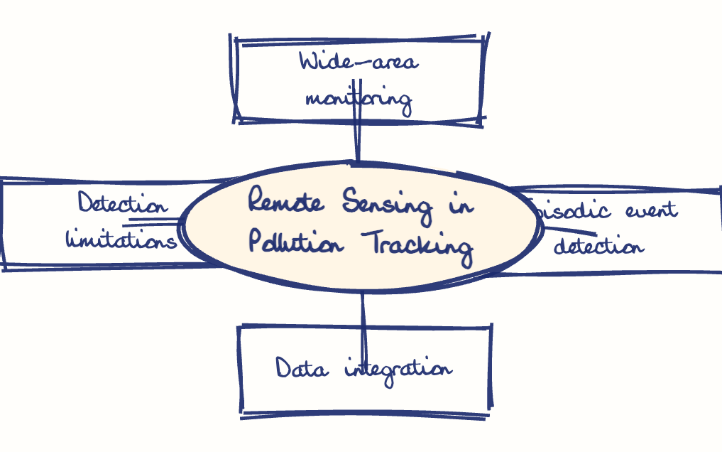
Remote sensing tracks pollutant dispersion over areas ground stations cannot cover, spotting episodes like stubble burning and linking sources to respiratory and cardiovascular harm. Because cloud cover, overpass timing and weak ground-level accuracy limit it, NCAP-aligned improvement needs hybrid ground networks, indigenous satellite products and open data.
Model answer
Ghissu Editorial · Verified 4 Oct 2026 · 291 words
Detection of Episodic Pollution Events
Satellite monitoring of paddy and wheat stubble burning in Punjab and Haryana, which affects NCR, has informed dynamic policy responses; adapting this to Andhra Pradesh’s paddy residue can curb seasonal pollution spikes. Additionally, remote sensing helps identify industrial emission hotspots, facilitating targeted interventions.
Increased Respiratory and Cardiovascular Risks
Exposure to PM2.5 and toxic gases raises chronic disease and mortality rates, especially near industrial corridors like Visakhapatnam in Andhra Pradesh. The rising death toll from air pollution nationally reflects similar local health burdens.
Technical Constraints and Data Gaps
Remote sensing struggles with cloud cover, limited detection hours, and cannot fully capture ground-level or indoor pollution; improving sensor technology and algorithms is vital. Cloud interference and timing issues can lead to underestimation of pollution events like stubble burning.
Capacity Building and Indigenous Technology
NCAP’s emphasis on indigenous satellite products and local expertise development will enhance data accuracy and policy relevance for states1 like Andhra Pradesh. Strengthening regional monitoring networks and integrating community data can improve responsiveness.
This model answer is indicative and the model can make mistakes; please verify key facts independently.
Practise this question
1Get the answer sheet
Sized for this question.
2Write your answer
Timed, by hand.
3Get it marked
Your score and what to fix.
This chapter in the exam
Pollution & solid waste; global issues; environmental legislation; disaster management policy; agricultural revolutions43 questions
Asked in 8 of 8 sittings since 2008
Most tested: Solid waste management and pollution-control legislation
- 2025What are the key principles of Integrated Solid Waste Management (ISWM)? Discuss the role of waste hierarchy in ISWM.
- 2025Define global warming, and differentiate it clearly from climate change. Explain the key natural and human-induced causes of global warming and briefly discuss which factors are currently dominant in driving global temperature rise.
All 43 questions, sorted by sub-topic, with model answers and practice.
Question from the official APPSC Group-I Mains 2025 paper. Answer written by Ghissu's engine and checked against our editorial standards. Found an error? Tell us and we correct it within 48 hours.