Analyse the socio-economic conditions under the Vijayanagara Rulers.
In short
Vijayanagara combined agrarian prosperity, structured land revenue, tank irrigation such as the Daroji Tank and vibrant markets with gold pagoda coinage and foreign trade, within a hierarchical varna-based society. Its Nayankara system of semi-autonomous Nayakas sustained the empire but, as Nayakas turned hereditary, fed fragmentation after Talikota in 1565.
Model answer
Ghissu Editorial · Verified 4 Oct 2026 · 249 words
Centralized Monarchy with Nayankara System
The Rayas delegated power to hereditary Nayakas, balancing control and local autonomy but causing eventual fragmentation. This Nayankara system required military and fiscal obligations from Nayakas, which sometimes led to defiance of imperial authority.
Agriculture and Irrigation Infrastructure
Large-scale irrigation projects like the Daroji Tank and canals harnessed the Tungabhadra River, supporting surplus production and food security. This investment underpinned the empire’s agrarian prosperity and trade capacity.
Varna System and Social Roles
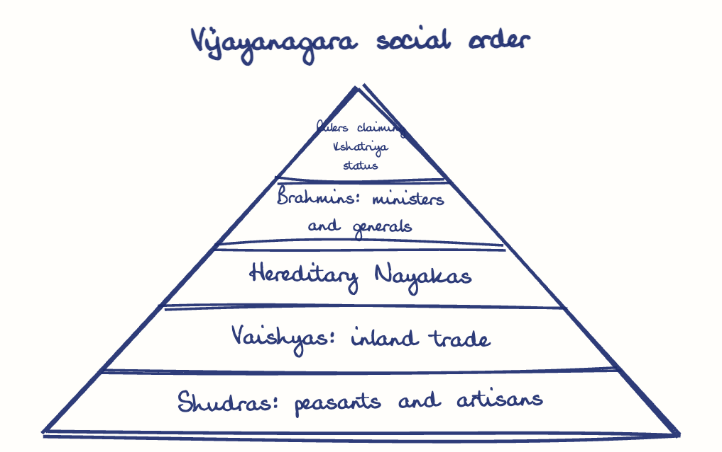
Brahmins dominated administration and military roles; Kshatriya status was claimed by rulers of peasant origin; Vaishyas managed trade. Women participated in diverse occupations including wrestling and accountancy, despite regressive practices like sati and child marriage.
Religious Patronage and Justice
The rulers patronized Hindu temples, Sanskrit and regional literature, and festivals like Navaratri, fostering social cohesion. Justice followed smriti traditions with the king as supreme judge; strict punishments and trial by ordeal maintained low crime rates, as noted by foreign travelers.
This model answer is indicative and the model can make mistakes; please verify key facts independently.
Practise this question
1Get the answer sheet
Sized for this question.
2Write your answer
Timed, by hand.
3Get it marked
Your score and what to fix.
This chapter in the exam
Islam, Bhakti and Sufi, Kakatiya to Mughal culture, composite culture3 questions
Asked in 2 of 2 sittings since 2016
Most tested: Composite culture through Islam’s influence and Indo-Islamic architectural fusion
Question from the official TGPSC Group-I Mains 2016 paper. Answer written by Ghissu's engine and checked against our editorial standards. Found an error? Tell us and we correct it within 48 hours.