Indo-Islamic architecture is marked by awe-inspiring fusion of Hindu, Persian and Provincial Styles. Discuss with examples.
In short
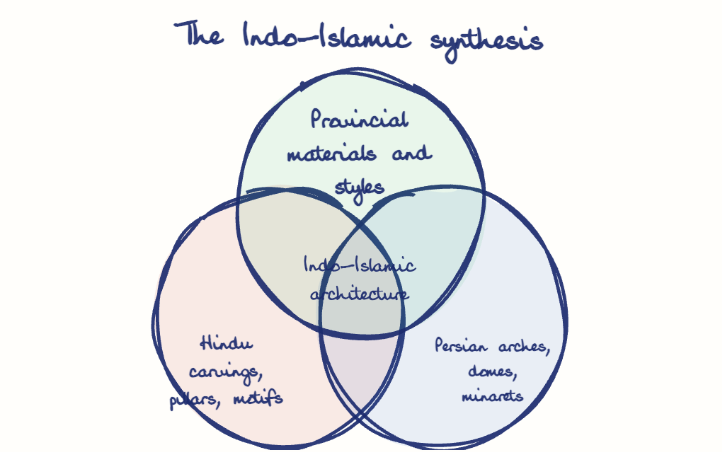
Indo-Islamic architecture fused Hindu carving, lotus motifs and pillars with Persian arches, domes, minarets and calligraphy, and adapted both to regional materials and styles. Examples include the Qutb Minar, Jaunpur's Atala Mosque, Fatehpur Sikri and the Deccani Qutbshahi tombs near Golconda Fort in Hyderabad.
Model answer
Ghissu Editorial · Verified 4 Oct 2026 · 265 words
Hindu Architectural Integration
Hindu motifs like lotus carvings, temple pillars, and toranas were adapted into Islamic structures, as seen in Gujarat’s mosques using lintels and corbelled brackets, reflecting temple traditions within Islamic religious contexts.
Persian Architectural Features
Persian arches, domes, minarets, and calligraphy transformed Indian architecture, exemplified by the Qutb Minar complex’s arcuate style and arabesque decorations, replacing the traditional trabeate style.
Provincial Adaptations and Local Materials
Regional styles in Bengal, Jaunpur, and Deccan incorporated local building materials and indigenous aesthetics; the Qutbshahi tombs near Golconda Fort blend Persian forms with indigenous stonework and decorative motifs, creating distinct architectural vocabularies.
Iconic Monuments
Fatehpur Sikri’s Mughal style combines grand arches, bulbous domes, and jali screens with Hindu chhatris and decorative brackets, producing a harmonious complex. Amer Fort shows Indo-Islamic influence beyond Muslim patronage through its use of jali work and arches.
Syncretism and Creative Hybridization
Sohel Hashmi1’s critique challenges essentialist views by emphasizing the creative fusion where Muslim patrons employed Hindu artisans, resulting in hybrid forms that respected both traditions and enriched architectural expression.
Education and Tourism
Integrate detailed modules on Indo-Islamic heritage in academic curricula and develop heritage circuits highlighting fusion in monuments to celebrate India’s composite culture and promote cultural tourism.
This model answer is indicative and the model can make mistakes; please verify key facts independently.
Sources
Practise this question
1Get the answer sheet
Sized for this question.
2Write your answer
Timed, by hand.
3Get it marked
Your score and what to fix.
This chapter in the exam
Islam, Bhakti and Sufi, Kakatiya to Mughal culture, composite culture3 questions
Asked in 2 of 2 sittings since 2016
Most tested: Composite culture through Islam’s influence and Indo-Islamic architectural fusion
Question from the official TGPSC Group-I Mains 2024 paper. Answer written by Ghissu's engine and checked against our editorial standards. Found an error? Tell us and we correct it within 48 hours.