Assess the salient features of Jainism and Buddhism.
In short
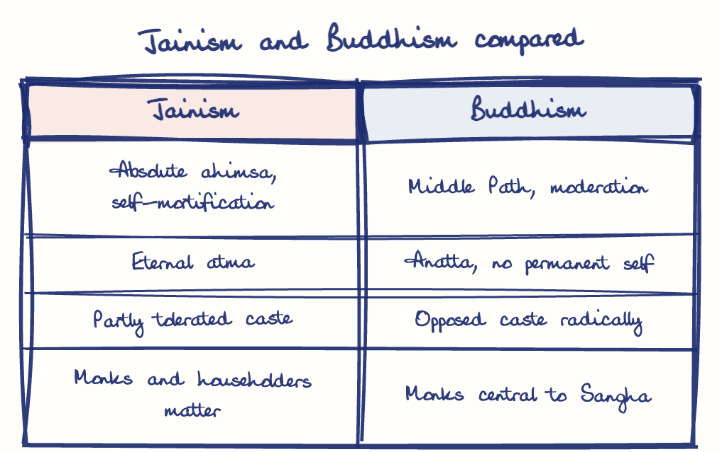
Jainism stresses absolute ahimsa, severe asceticism, anekantavada and an eternal soul, while Buddhism teaches the Middle Path, the Four Noble Truths and Eightfold Path, and denies a permanent self (anatta). Both arose in the 6th century BCE from Kshatriya founders who rejected Vedic ritual authority and promoted ethical living.
Model answer
Ghissu Editorial · Verified 4 Oct 2026 · 257 words
Buddhism’s Four Noble Truths1 and Eightfold Path
These core teachings diagnose suffering and prescribe ethical and mental discipline for liberation. They emphasize practical steps like right speech, right action, and meditation to end dukkha.
Buddhism’s Middle Path
Avoiding extremes of indulgence and asceticism, this approach made Buddhism accessible and facilitated its global spread. The Buddha’s rejection of harsh austerities attracted diverse followers and royal patronage.
Philosophical Differences
Jainism believes in an eternal soul (atma), while Buddhism denies a permanent self (anatta), influencing their ethical outlooks and concepts of rebirth and liberation.
Social and Institutional Roles
Jainism tolerated caste and family life; Buddhism opposed caste and emphasized a monastic Sangha supported by lay followers. Buddhism’s Sangha became a key institution for spreading its teachings across Asia.
Ethical Education
Integrating Jain and Buddhist values of non-violence, anekantavada and self-discipline into value education can foster tolerance and ethical conduct among citizens.
Heritage and Cultural Diplomacy
Conserving Buddhist and Jain sites such as Nagarjunakonda in Andhra Pradesh and Phanigiri in Telangana, and promoting Buddhist circuits, can deepen India’s ties with Asian countries.
This model answer is indicative and the model can make mistakes; please verify key facts independently.
Sources
Practise this question
1Get the answer sheet
Sized for this question.
2Write your answer
Timed, by hand.
3Get it marked
Your score and what to fix.
This chapter in the exam
Early civilisations, Buddhism and Jainism, art schools, Mauryas to Guptas4 questions
Asked in 2 of 2 sittings since 2016
Most tested: Buddhism and its spread/acceptance, especially in relation to social and economic conditions and artistic expression.
- 2024Analyse the Stylistic and Iconographic differences between Gandhara and Mathura schools of art.
- 2024Buddhism and Jainism gained wide acceptance due to the then prevailing socio-economic conditions in India. Analyse.
All 4 questions, sorted by sub-topic, with model answers and practice.
Question from the official TGPSC Group-I Mains 2016 paper. Answer written by Ghissu's engine and checked against our editorial standards. Found an error? Tell us and we correct it within 48 hours.