Buddhism and Jainism gained wide acceptance due to the then prevailing socio-economic conditions in India. Analyse.
In short
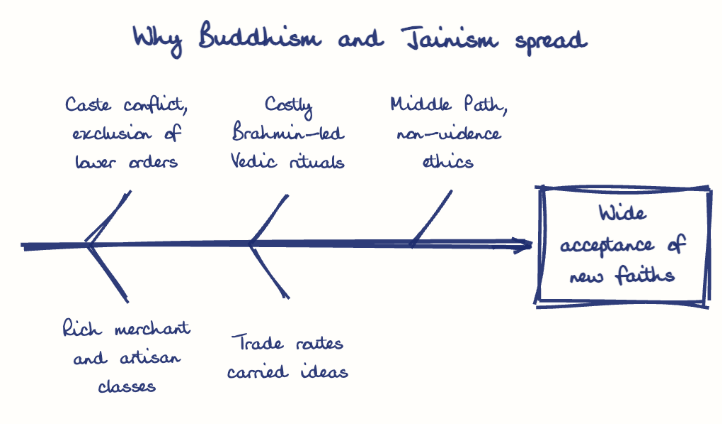
Buddhism and Jainism spread in the 6th-5th centuries BCE because caste rigidity, costly Vedic ritual and the rise of trade and cities created demand for egalitarian, ethical faiths. Prosperous merchants and artisans and Mahajanapada rulers like Bimbisara patronised them, carrying them along trade routes.
Model answer
Ghissu Editorial · Verified 4 Oct 2026 · 257 words
Economic Changes and Urbanization
Growth of trade, commerce, and crafts empowered merchant and artisan classes who patronized Buddhist monasteries and Jain temples, facilitating religious spread along trade routes and urban centres.
Decline of Vedic Ritualism
The costly Brahminical rituals lost appeal among urban middle classes, who preferred Buddhism’s Four Noble Truths1 and ethical focus on the Middle Path, as well as Jainism’s emphasis on personal austerity.
Trade Networks and Urban Centres
Trade routes and cities like Nalanda became hubs for Buddhist and Jain teachings, supported by merchant patronage that linked diverse regions and facilitated cultural exchange.
Social Reform and Religious Evolution
Buddhism’s Middle Path and Jainism’s asceticism addressed societal anxieties amid change, while later developments like Navayana Buddhism2 offered modern reinterpretations appealing to marginalized groups.
Inclusive Heritage Education
Promoting teachings of Buddhism and Jainism in curricula can foster social harmony by highlighting their socio-economic roots and ethical values.
Support Archaeological and Cultural Preservation
Encouraging preservation of Buddhist and Jain sites can deepen understanding of their historical role in shaping Indian society.
This model answer is indicative and the model can make mistakes; please verify key facts independently.
Practise this question
1Get the answer sheet
Sized for this question.
2Write your answer
Timed, by hand.
3Get it marked
Your score and what to fix.
This chapter in the exam
Early civilisations, Buddhism and Jainism, art schools, Mauryas to Guptas4 questions
Asked in 2 of 2 sittings since 2016
Most tested: Buddhism and its spread/acceptance, especially in relation to social and economic conditions and artistic expression.
- 2024Analyse the Stylistic and Iconographic differences between Gandhara and Mathura schools of art.
- 2016Compare and contrast the salient features of Indus and Vedic Civilization.
All 4 questions, sorted by sub-topic, with model answers and practice.
Question from the official TGPSC Group-I Mains 2024 paper. Answer written by Ghissu's engine and checked against our editorial standards. Found an error? Tell us and we correct it within 48 hours.