Analyse the Stylistic and Iconographic differences between Gandhara and Mathura schools of art.
In short
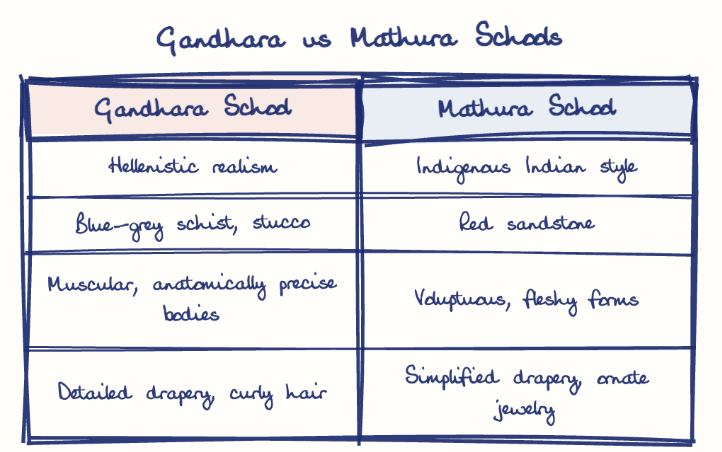
Gandhara art used blue-grey schist and Hellenistic realism, with muscular bodies, wavy hair and toga-like drapery, while Mathura used red sandstone and an indigenous yaksha-based style of fleshy forms and ornate jewellery. Gandhara was mainly Buddhist, whereas Mathura also carved Hindu and Jain deities with larger decorated halos.
Model answer
Ghissu Editorial · Verified 4 Oct 2026 · 292 words
Mathura’s Indigenous Style
Mathura art, carved from red sandstone, emphasizes robust, fleshy forms with simplified drapery and elaborate jewelry, rooted in yaksha traditions. The sculptures have a tactile, earthy texture and project vitality through sensuous curves.
Symbolism in Mathura Art
Garments cover the left shoulder distinctly, and figures wear ornate jewelry, reflecting local cultural aesthetics and religious symbolism rather than anatomical precision.
Buddha Depictions
Gandhara Buddhas have sharp features, realistic robes, and contrapposto stance; Mathura Buddhas show rounder faces, symbolic halos, and frontal postures with narrative reliefs. Gandhara’s style emphasizes naturalism, while Mathura focuses on spiritual presence.
Religious Themes
Mathura art includes Hindu deities like Vishnu and Shiva alongside Buddhist and Jain images; Gandhara focuses mainly on Buddhist themes inspired by Greco-Roman gods such as Apollo, highlighting different theological emphases.
Education Integration
Incorporate detailed studies of Gandhara and Mathura art into school and university curricula to foster appreciation of India’s rich artistic heritage and its syncretic evolution.
This model answer is indicative and the model can make mistakes; please verify key facts independently.
Practise this question
1Get the answer sheet
Sized for this question.
2Write your answer
Timed, by hand.
3Get it marked
Your score and what to fix.
This chapter in the exam
Early civilisations, Buddhism and Jainism, art schools, Mauryas to Guptas4 questions
Asked in 2 of 2 sittings since 2016
Most tested: Buddhism and its spread/acceptance, especially in relation to social and economic conditions and artistic expression.
- 2024Buddhism and Jainism gained wide acceptance due to the then prevailing socio-economic conditions in India. Analyse.
- 2016Compare and contrast the salient features of Indus and Vedic Civilization.
All 4 questions, sorted by sub-topic, with model answers and practice.
Question from the official TGPSC Group-I Mains 2024 paper. Answer written by Ghissu's engine and checked against our editorial standards. Found an error? Tell us and we correct it within 48 hours.