Bring out the significance of Gandhian era in Indian freedom struggle.
In short
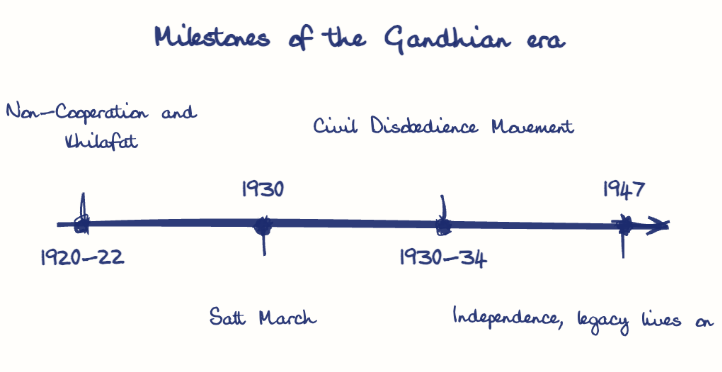
The Gandhian era turned the freedom struggle from an elite movement into a mass, non-violent one through satyagraha, Non-Cooperation, the 1930 Salt March and Civil Disobedience, linking politics to social reform and khadi. In the Telugu lands, the Chirala-Perala and Pedanandipadu struggles of 1921-22 showed its village reach.
Model answer
Ghissu Editorial · Verified 4 Oct 2026 · 261 words
Mass Mobilization through Satyagraha
Gandhi’s philosophy of truth and non-violence mobilized millions across classes via the Non-Cooperation (1920-22) and Civil Disobedience (1930-34) movements, turning the struggle into a nationwide mass movement.
Non-Violence as Strategic Tool
Gandhi’s civil disobedience reduced British repression and inspired global leaders like Martin Luther King Jr. and Nelson Mandela. This ethical approach gained international sympathy and legitimacy for India’s cause.
Unification of Diverse Communities
His emphasis on Hindu-Muslim unity maintained pan-Indian identity, preventing communal fragmentation. The Khilafat movement exemplified this inclusive nationalism, fostering solidarity across religious lines.
Foundation for Democratic India
Gandhi’s Gram Swaraj vision influenced the 73rd Constitutional Amendment institutionalizing Panchayati Raj and social justice policies like Scheduled Caste reservations, embedding grassroots democracy and equality.
Global Legacy1 of Non-Violence
The UN’s International Day of Non-Violence on October 2 highlights Gandhi’s worldwide influence. His philosophy continues to inspire peace and civil rights movements globally.
Gandhi’s Trusteeship Concept
Advocating wealth holders as trustees for public welfare, this concept shaped ethical governance and influenced post-independence economic thought on equitable resource distribution.
This model answer is indicative and the model can make mistakes; please verify key facts independently.
Sources
Practise this question
1Get the answer sheet
Sized for this question.
2Write your answer
Timed, by hand.
3Get it marked
Your score and what to fix.
This chapter in the exam
Freedom struggle 1885-1947, peasant, worker, tribal and women's movements, partition4 questions
Asked in 2 of 2 sittings since 2016
Most tested: Peasant movements and agrarian concerns in the freedom struggle.
- 2024Peasants' concerns were integral to the issues raised by the struggle for Indian independence. Illustrate with reference to the Bardoli Satyagraha.
- 2016Examine the nature and impact of the peasant movements during 1885-1947.
All 4 questions, sorted by sub-topic, with model answers and practice.
Question from the official TGPSC Group-I Mains 2016 paper. Answer written by Ghissu's engine and checked against our editorial standards. Found an error? Tell us and we correct it within 48 hours.