Peasants' concerns were integral to the issues raised by the struggle for Indian independence. Illustrate with reference to the Bardoli Satyagraha.
In short
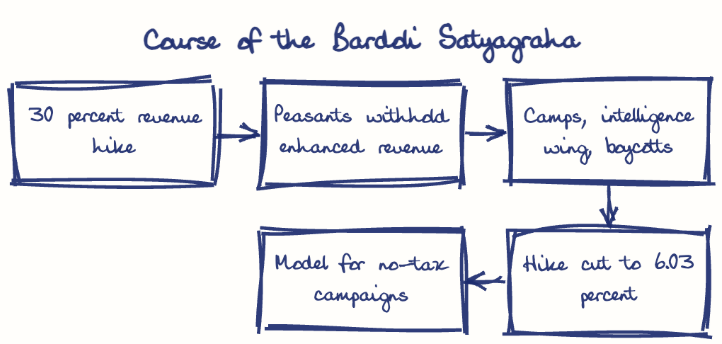
Peasant grievances over high revenue, insecure tenure, debt and forced labour were central to the freedom struggle and gave it a mass base. In the Bardoli Satyagraha (1928), Vallabhbhai Patel led peasants to withhold a 30% revenue hike, forcing the government to cut it to 6.03%.
Model answer
Ghissu Editorial · Verified 4 Oct 2026 · 263 words
Economic Exploitation and Debt
Peasants suffered from high land revenue, zamindari oppression, and indebtedness, demanding tenancy reforms and debt relief as seen in Kisan Sabhas.
Forced Labour and Illegal Taxes
Movements like Tebhaga protested against forced labour and illegal exactions disrupting rural life.
Revenue Hike Trigger
The British 30 percent land revenue increase in Bardoli taluka, deemed unjustified after the Bardoli Inquiry Committee, sparked the satyagraha.
Leadership of Vallabhbhai Patel
Patel led disciplined resistance, withholding payments and demanding fair assessment or tribunal.
Mass Mobilization and Women’s Role
Social boycotts and workers’ camps ensured compliance; women’s active participation earned Patel the title “Sardar.”
Government Concession
National attention forced the government to reduce the hike to 6.03 percent.
Linking Grievances with Nationalism
Bardoli integrated peasant economic issues into the anti-colonial struggle under Gandhi and Patel.
Empowerment through Organization
Bardoli inspired Kisan Sabhas as platforms for rural concerns aligned with national goals.
Gandhian Nonviolence
The satyagraha demonstrated effective mass mobilization through moral authority.
Catalyst for Later Movements
Bardoli set a precedent for Civil Disobedience-era no-rent campaigns.
Strengthen Rural Political Education
Promote democratic participation via Panchayats.
Promote Agrarian Reforms
Ensure tenure security and debt relief.
Encourage Women’s Participation
Build on Bardoli’s example.
This model answer is indicative and the model can make mistakes; please verify key facts independently.
Practise this question
1Get the answer sheet
Sized for this question.
2Write your answer
Timed, by hand.
3Get it marked
Your score and what to fix.
This chapter in the exam
Freedom struggle 1885-1947, peasant, worker, tribal and women's movements, partition4 questions
Asked in 2 of 2 sittings since 2016
Most tested: Peasant movements and agrarian concerns in the freedom struggle.
- 2016Bring out the significance of Gandhian era in Indian freedom struggle.
- 2016Examine the nature and impact of the peasant movements during 1885-1947.
All 4 questions, sorted by sub-topic, with model answers and practice.
Question from the official TGPSC Group-I Mains 2024 paper. Answer written by Ghissu's engine and checked against our editorial standards. Found an error? Tell us and we correct it within 48 hours.