Examine the nature and impact of the peasant movements during 1885-1947.
In short
Peasant movements of 1885-1947 arose from heavy colonial revenue, landlordism and debt, ranging from petitions to militant uprisings like Tebhaga and the Telangana Rebellion. They linked agrarian grievances to the national movement through Champaran (1917) and Bardoli (1928) and paved the way for zamindari abolition, though they stayed regionally fragmented.
Model answer
Ghissu Editorial · Verified 4 Oct 2026 · 270 words
Economic Grievances and Examples
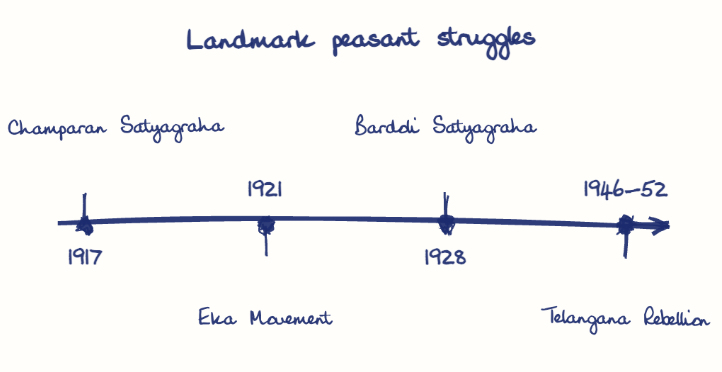
Oppressive colonial land revenue systems like Permanent Settlement and Ryotwari caused heavy taxation and indebtedness, forcing many peasants into tenancy or landlessness. The Champaran Satyagraha (1917) protested indigo planter exploitation, marking a key early resistance.
Leadership and Social Dimensions
Initially led by local rural leaders, these movements later involved national figures such as Gandhi and leftist leaders who radicalized struggles, exemplified by the Telangana Rebellion. They addressed not only economic but also social oppression, including caste discrimination, as seen in the Tebhaga Movement and Mappila Rebellion.
Raised Peasant Awareness and Mobilization
Movements like the Eka Movement (1921) educated peasants about their rights and mobilized them against exploitative landlords. Under Gandhi’s leadership in Champaran and Bardoli (1928), agrarian grievances were linked with nationalist goals, broadening mass participation.
Legal Literacy and Inclusive Reforms
Expanding rural legal awareness on land and tenancy rights is essential, alongside implementing equitable land distribution policies for marginalized groups like sharecroppers and landless laborers.
Grassroots Leadership and Policy Integration
Developing leadership from within rural communities and aligning agricultural policies with peasant aspirations will ensure sustainable livelihoods and long-term mobilization.
This model answer is indicative and the model can make mistakes; please verify key facts independently.
Practise this question
1Get the answer sheet
Sized for this question.
2Write your answer
Timed, by hand.
3Get it marked
Your score and what to fix.
This chapter in the exam
Freedom struggle 1885-1947, peasant, worker, tribal and women's movements, partition4 questions
Asked in 2 of 2 sittings since 2016
Most tested: Peasant movements and agrarian concerns in the freedom struggle.
- 2024Peasants' concerns were integral to the issues raised by the struggle for Indian independence. Illustrate with reference to the Bardoli Satyagraha.
- 2016Bring out the significance of Gandhian era in Indian freedom struggle.
All 4 questions, sorted by sub-topic, with model answers and practice.
Question from the official TGPSC Group-I Mains 2016 paper. Answer written by Ghissu's engine and checked against our editorial standards. Found an error? Tell us and we correct it within 48 hours.