Compare and contrast the salient features of Brahma Samaj and Arya Samaj movement and their impact on the Indian Society.
In short
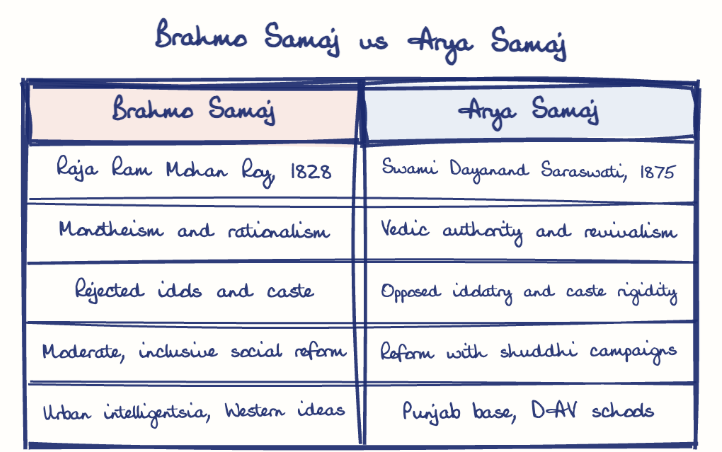
The Brahmo Samaj (Raja Ram Mohan Roy, 1828) was a rationalist reform movement against idolatry, caste and sati, while the Arya Samaj (Dayanand Saraswati, 1875) joined reform to Vedic revivalism and shuddhi. Both advanced women's education, inspiring Kandukuri Veeresalingam's widow remarriages from 1881, but stayed largely urban and upper-caste.
Model answer
Ghissu Editorial · Verified 4 Oct 2026 · 401 words
Founders and Philosophies
Brahmo Samaj, founded by Raja Ram Mohan Roy in 1828, emphasized monotheism, rejected idol worship and caste discrimination, promoting rationalism and universalism; Arya Samaj, founded by Swami Dayanand Saraswati in 1875, asserted Vedic authority, opposed caste rigidity, and pursued Hindu revivalism with shuddhi (reconversion) campaigns to restore Hindu unity.
Social Reform Methods
Brahmo Samaj advocated abolition of sati (banned in 1829), widow remarriage, and women’s education with a moderate, inclusive approach; Arya Samaj combined social reform with aggressive Hindu revivalism, establishing Dayanand Anglo-Vedic schools promoting Hindi and English education and emphasizing Vedic teachings.
Educational and Social Contributions
Arya Samaj’s Dayanand Anglo-Vedic institutions spread modern education blending traditional values; Brahmo Samaj influenced urban reformist leaders, fostering rational thought, social equality, and legislative reforms like the banning of sati.
Inclusive Reform and Unity
Future reforms must actively engage rural and marginalized groups, balance revivalism with pluralism and interfaith harmony, expand holistic education combining tradition with scientific temper, and strengthen collaboration among reformers for sustained social progress.
This model answer is indicative and the model can make mistakes; please verify key facts independently.
Practise this question
1Get the answer sheet
Sized for this question.
2Write your answer
Timed, by hand.
3Get it marked
Your score and what to fix.
This chapter in the exam
Revolts of the 19th century, 1857, socio-religious and anti-caste movements5 questions
Asked in 2 of 2 sittings since 2016
Most tested: Anti-caste and social reform movements’ impact on Indian society and politics.
- 2024The major 19th Century tribal movements such as the Santhal Rebellion and the Munda Rebellion shaped the trajectory of Indian resistance against colonial rule. Discuss.
- 2024The nature of British rule and colonial policies significantly altered after the 1857 revolt. Discuss.
All 5 questions, sorted by sub-topic, with model answers and practice.
Question from the official TGPSC Group-I Mains 2016 paper. Answer written by Ghissu's engine and checked against our editorial standards. Found an error? Tell us and we correct it within 48 hours.