The nature of British rule and colonial policies significantly altered after the 1857 revolt. Discuss.
In short
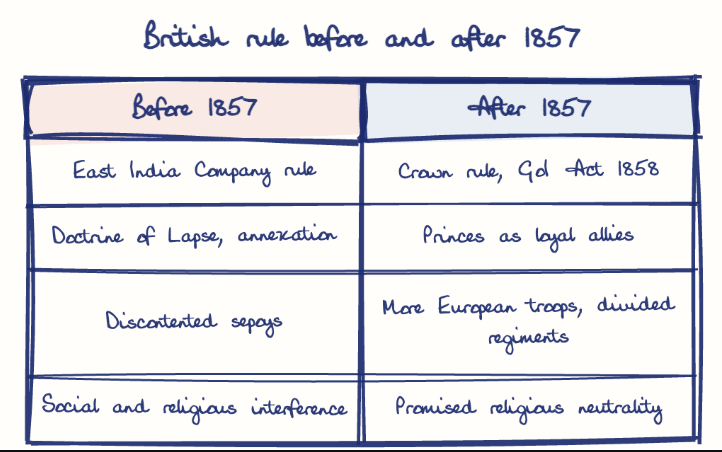
After 1857, British rule shifted from company conquest to a centralised imperial state that courted princes and reorganised the army on caste and regional lines to divide and rule. The Government of India Act 1858 abolished the East India Company and the Doctrine of Lapse was ended.
Model answer
Ghissu Editorial · Verified 4 Oct 2026 · 270 words
Limited Indian Participation and Social Interference
Indians were excluded from civil services due to discriminatory exams; social reforms like abolition of sati and missionary activities fueled cultural resentment and fears of religious interference.
Military Reorganization and Divide-and-Rule
Increased European troops, restricted artillery to Europeans, reorganized Indian regiments by caste and region to prevent unity, institutionalizing divide-and-rule to curb future rebellions.
Policy Shift on Princely States
Doctrine of Lapse ended; princely rulers were assured security and the right to adopt heirs, securing their loyalty and stabilizing indirect rule.
Racial and Communal Policies
Despite Queen Victoria’s 1858 proclamation promising equality and religious neutrality, racial discrimination intensified; Muslims, blamed for the revolt, faced repression, deepening communal divides and complicating nationalist unity.
Consolidation of British Authority
Direct Crown rule brought bureaucratic reforms and military restructuring, including the Indian Civil Services Act of 1861 that kept the higher services under firm British control, to prevent future revolts and enhance administrative efficiency.
Entrenchment of Racial Hierarchies and Communal Divisions
Policies institutionalized racial superiority and exacerbated Hindu-Muslim tensions through exclusion and repression, hindering the emergence of a unified nationalist movement.
This model answer is indicative and the model can make mistakes; please verify key facts independently.
Practise this question
1Get the answer sheet
Sized for this question.
2Write your answer
Timed, by hand.
3Get it marked
Your score and what to fix.
This chapter in the exam
Revolts of the 19th century, 1857, socio-religious and anti-caste movements5 questions
Asked in 2 of 2 sittings since 2016
Most tested: Anti-caste and social reform movements’ impact on Indian society and politics.
- 2024The major 19th Century tribal movements such as the Santhal Rebellion and the Munda Rebellion shaped the trajectory of Indian resistance against colonial rule. Discuss.
- 2024Discuss the ideological differences between Gandhi and Ambedkar on Socio-Political issues and how the Poona Pact of 1932 showed the way.
All 5 questions, sorted by sub-topic, with model answers and practice.
Question from the official TGPSC Group-I Mains 2024 paper. Answer written by Ghissu's engine and checked against our editorial standards. Found an error? Tell us and we correct it within 48 hours.