The major 19th Century tribal movements such as the Santhal Rebellion and the Munda Rebellion shaped the trajectory of Indian resistance against colonial rule. Discuss.
In short
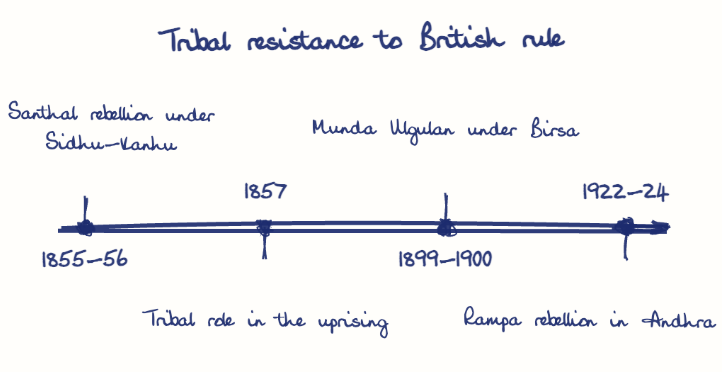
The Santhal Rebellion (1855-56) under Sidhu and Kanhu and Birsa Munda's Ulgulan (1899-1900) resisted land alienation, moneylenders and colonial exploitation, widening the social base of anti-colonial struggle. Though crushed, they won protective laws such as the Santhal Parganas Settlement Regulation (1872) and the Chotanagpur Tenancy Act (1908).
Model answer
Ghissu Editorial · Verified 4 Oct 2026 · 265 words
Santhal Rebellion
Led by Sidhu and Kanhu Murmu, it was a mass uprising against British revenue policies and landlords, resulting in the Santhal Pargana’s creation to protect tribal interests. The rebellion temporarily disrupted colonial administration and highlighted tribal resistance to economic exploitation.
Munda Rebellion
Birsa Munda’s Ulgulan movement resisted land alienation and missionary interference, influencing the Chotanagpur Tenancy Act to safeguard tribal lands. Birsa’s emphasis on reviving tribal customs combined religious revival with political assertion.
Subaltern Agency and Leadership
Charismatic leaders like Birsa Munda mobilized tribal identity and resistance, combining socio-religious revival with anti-colonial struggle. These movements used traditional weapons and reflected indigenous resolve despite limited access to modern arms.
Integration with National Movement
Later 20th-century movements like the Tana Bhagat adopted Gandhian non-violence, linking tribal grievances with broader Indian nationalism. This transition marked the gradual alignment of tribal struggles with the mainstream freedom movement.
Legislative Outcomes
Uprisings pressured the British to adopt measures protecting tribal land rights, such as the Santhal Parganas Settlement Regulation (1872) and the Chotanagpur Tenancy Act (1908), marking early institutional recognition of tribal issues.
This model answer is indicative and the model can make mistakes; please verify key facts independently.
Practise this question
1Get the answer sheet
Sized for this question.
2Write your answer
Timed, by hand.
3Get it marked
Your score and what to fix.
This chapter in the exam
Revolts of the 19th century, 1857, socio-religious and anti-caste movements5 questions
Asked in 2 of 2 sittings since 2016
Most tested: Anti-caste and social reform movements’ impact on Indian society and politics.
- 2024The nature of British rule and colonial policies significantly altered after the 1857 revolt. Discuss.
- 2024Discuss the ideological differences between Gandhi and Ambedkar on Socio-Political issues and how the Poona Pact of 1932 showed the way.
All 5 questions, sorted by sub-topic, with model answers and practice.
Question from the official TGPSC Group-I Mains 2024 paper. Answer written by Ghissu's engine and checked against our editorial standards. Found an error? Tell us and we correct it within 48 hours.