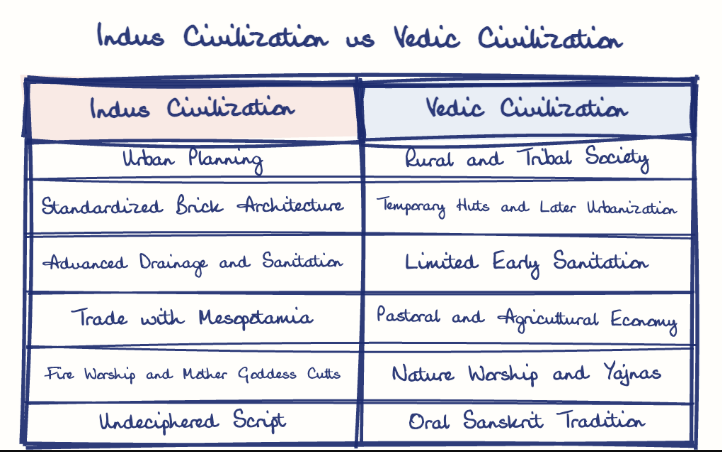
Compare and contrast the salient features of Indus and Vedic Civilization.
In short
The Indus Civilization (about 2600 to 1900 BCE) was urban, with grid-planned cities, standard bricks, advanced drainage and Mesopotamian trade, whereas early Vedic society was rural, pastoral and tribal. Both knew fire worship, but the Indus script is undeciphered while Vedic culture rested on an oral Sanskrit tradition.
Model answer
Ghissu Editorial · Verified 4 Oct 2026 · 342 words
Indus Economy and Trade
Agriculture, animal domestication, metallurgy (copper, bronze), and trade with Mesopotamia via ports like Lothal highlight economic complexity. Craft production and long-distance trade networks demonstrate a prosperous and interconnected economy.
Vedic Socio-Political and Economic Shift
Early Vedic tribal pastoralism with elected Rajans and assemblies (Sabha, Samiti) evolved into settled agriculture with iron tools and emerging urban centers like Kaushambi. The varna system became more rigid, reflecting social stratification alongside political centralization.
Vedic Religion and Social Structure
Nature worship, fire sacrifices (yajnas), hymns to Indra, Agni, and Varuna, later elaborate ritual and Upanishadic thought; patriarchal varna system and Sanskrit oral literature shaped culture. Women’s status declined over time, and joint family systems became prevalent, while ritual codification influenced social duties.
This model answer is indicative and the model can make mistakes; please verify key facts independently.
Sources
Practise this question
1Get the answer sheet
Sized for this question.
2Write your answer
Timed, by hand.
3Get it marked
Your score and what to fix.
This chapter in the exam
Early civilisations, Buddhism and Jainism, art schools, Mauryas to Guptas4 questions
Asked in 2 of 2 sittings since 2016
Most tested: Buddhism and its spread/acceptance, especially in relation to social and economic conditions and artistic expression.
- 2024Analyse the Stylistic and Iconographic differences between Gandhara and Mathura schools of art.
- 2024Buddhism and Jainism gained wide acceptance due to the then prevailing socio-economic conditions in India. Analyse.
All 4 questions, sorted by sub-topic, with model answers and practice.
Question from the official TGPSC Group-I Mains 2016 paper. Answer written by Ghissu's engine and checked against our editorial standards. Found an error? Tell us and we correct it within 48 hours.