Discuss the role of leftist parties in anti-feudal and anti-colonial struggles.
In short
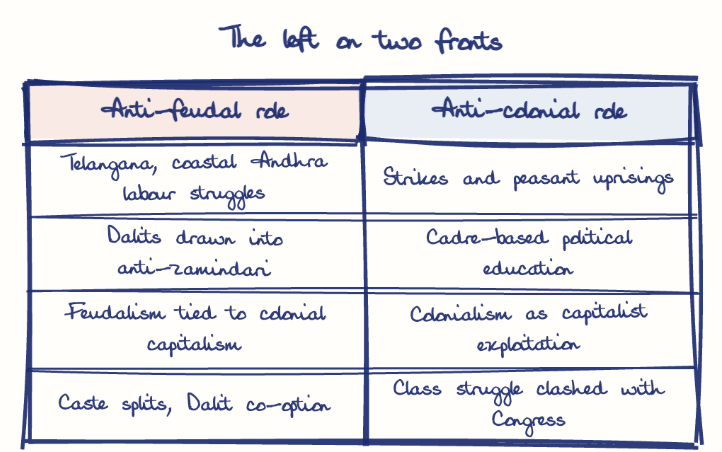
Leftist parties joined the fight against feudal exploitation to the anti-colonial struggle, mobilising peasants, workers and Dalits through Marxist critique, strikes and militant agrarian action. Their most dramatic role was the Telangana armed struggle (1946-51) against the Nizam's jagirdars, though caste-class tensions and friction with the Congress limited them.
Model answer
Ghissu Editorial · Verified 4 Oct 2026 · 257 words
Peasant Mobilization in Telangana and Andhra
The Communist Party of India led militant struggles in the 1930s-40s, involving Dalit and lower-caste agricultural workers against zamindari landlords. The Telangana Rebellion (1946-51) exemplified this armed peasant uprising against feudal oppression and colonial landlords.
Dalit Leadership and Social Justice
Figures like Guntur Bapanaiah joined the Communist movement, which advocated abolishing untouchability as essential for social equality. The left’s emphasis on caste abolition complemented its anti-feudal agenda, although Dalit leaders sometimes faced co-option by dominant parties like Congress.
Mass Mobilization and Political Education
The Communist Party’s cadre-based organization politicized rural and working classes, linking economic grievances to national freedom. Their efforts in Andhra and Telangana educated peasants and workers on colonial oppression, fostering sustained resistance.
Caste Contradictions
Caste divisions sometimes undermined class solidarity, limiting the left’s reach in certain regions. The complex interplay of caste and class posed challenges to forging a unified front, as seen in the partial absorption of Dalit leaders into mainstream nationalist politics.
This model answer is indicative and the model can make mistakes; please verify key facts independently.
Sources
Practise this question
1Get the answer sheet
Sized for this question.
2Write your answer
Timed, by hand.
3Get it marked
Your score and what to fix.
This chapter in the exam
Freedom struggle 1885-1947, peasant, worker, tribal and women's movements, partition4 questions
Asked in 2 of 2 sittings since 2016
Most tested: Peasant movements and agrarian concerns in the freedom struggle.
- 2024Peasants' concerns were integral to the issues raised by the struggle for Indian independence. Illustrate with reference to the Bardoli Satyagraha.
- 2016Bring out the significance of Gandhian era in Indian freedom struggle.
All 4 questions, sorted by sub-topic, with model answers and practice.
Question from the official TGPSC Group-I Mains 2016 paper. Answer written by Ghissu's engine and checked against our editorial standards. Found an error? Tell us and we correct it within 48 hours.