Present a note on the key features of the India's State of Forest Report 2015 of Forest Survey of India.
In short
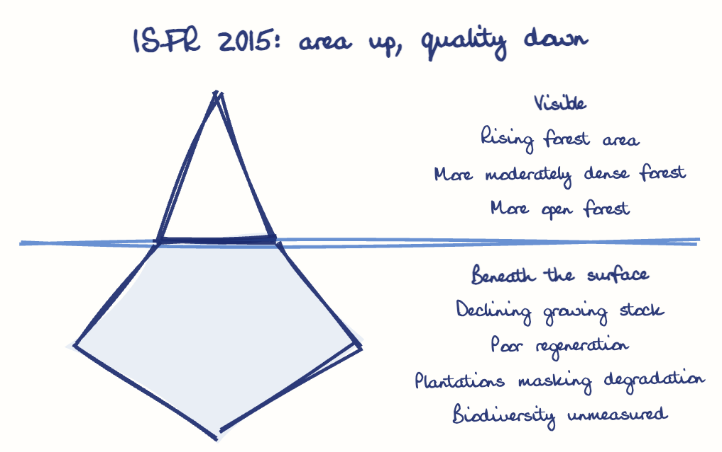
The Forest Survey of India's ISFR 2015 mapped forest cover by satellite and ground checks, classing patches above one hectare with over 10% canopy as very dense, moderately dense or open forest. It put forest cover at 21.34% of India's area but warned of declining growing stock and degradation.
Model answer
Ghissu Editorial · Verified 4 Oct 2026 · 245 words
Forest Cover Definition and Classification
Forest cover includes all land with >10% canopy density over one hectare, classified into Very Dense, Moderately Dense, and Open Forest for detailed analysis.
Remote Sensing and Coordination
Uses satellite imagery combined with ground truthing; FSI coordinates with state forest departments under the Ministry of Environment, Forest and Climate Change.
Forest Cover Status and Regional Variation
ISFR 2015 put India’s forest cover at about 21.34% of its area, with dense forests in the northeast and central regions, and sparse cover in arid zones.
Increase in Forest Cover and Degradation Concerns
Gains in moderately dense and open forests reflect afforestation efforts and schemes like the National Afforestation Programme2, but declining growing stock signals degradation risks.
Monitoring and Community Involvement
Calls for improved forest quality monitoring and integrating forest-dependent communities’ rights under the Forest Rights Act.
Balancing Development and Conservation
Emphasizes stricter regulatory frameworks like the Forest Conservation Act and compensatory afforestation under CAMPA.
Promoting Agroforestry
Supports policies like the National Agroforestry Policy to expand tree cover beyond forests.
This model answer is indicative and the model can make mistakes; please verify key facts independently.
Practise this question
1Get the answer sheet
Sized for this question.
2Write your answer
Timed, by hand.
3Get it marked
Your score and what to fix.
This chapter in the exam
India: physical setting, climate, resources and water3 questions
Asked in 2 of 2 sittings since 2016
Most tested: Water resources and their management, especially rivers and monsoon-linked water availability.
Question from the official TGPSC Group-I Mains 2016 paper. Answer written by Ghissu's engine and checked against our editorial standards. Found an error? Tell us and we correct it within 48 hours.