Explain in detail the influence of locational aspects of Himalayas and Tibetan Plateau in the mechanism of Monsoons in India.
In short
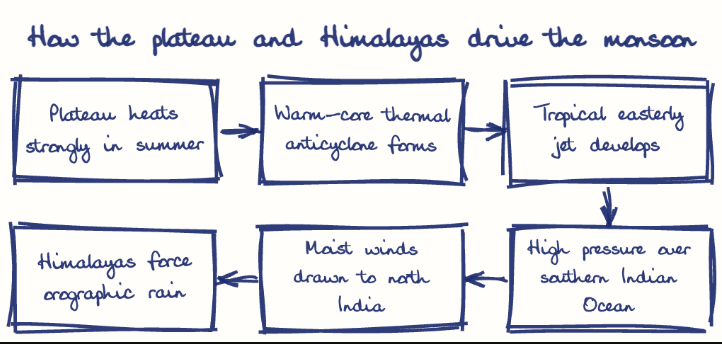
The Himalayas block cold Central Asian air and force moist monsoon winds to rise and rain, while the Tibetan Plateau acts as a summer heat engine. Its heating, at an average height of about 4,000 metres, creates an anticyclone and the tropical easterly jet that drive the southwest monsoon.
Model answer
Ghissu Editorial · Verified 4 Oct 2026 · 318 words
Northern Mountain Barrier
The Himalayas stretch northwest to northeast, blocking cold Central Asian air and protecting India from severe winters.
Orographic Rainfall and Jet Stream
Their height forces moist monsoon winds upward, causing rainfall on southern slopes, while influencing the subtropical westerly jet’s northward summer shift, signaling monsoon onset.
High Elevation Heat Source
The 4000m-high Tibetan Plateau heats the air above it more than surrounding regions, creating a thermal anticyclone and tropical easterly jet that intensify monsoon winds.
Snow Cover Influence
Heavy snow reduces heating, weakening the easterly jet and monsoon strength, impacting rainfall over India.
Thermal Contrast Drives Monsoon
The Himalayas’ barrier plus Plateau heating create thermal gradients that drive moist winds from the Indian Ocean into India.
Jet Stream Dynamics
Seasonal shifts of the subtropical westerly jet and tropical easterly jet regulate monsoon timing and intensity.
Rainfall Distribution
Orographic uplift and Plateau heating sustain monsoon troughs and low-pressure systems for widespread precipitation.
Climate Variability Link
Tibetan snow cover and ENSO modulate monsoon variability, affecting agriculture and water security.
Enhanced Monitoring and Research
Strengthen meteorological networks and study snow cover dynamics on the Tibetan Plateau for better monsoon forecasts.
Water Resource Management
Develop adaptive plans considering Himalayan and Plateau influences to ensure sustainable water availability.
This model answer is indicative and the model can make mistakes; please verify key facts independently.
Practise this question
1Get the answer sheet
Sized for this question.
2Write your answer
Timed, by hand.
3Get it marked
Your score and what to fix.
This chapter in the exam
India: physical setting, climate, resources and water3 questions
Asked in 2 of 2 sittings since 2016
Most tested: Water resources and their management, especially rivers and monsoon-linked water availability.
Question from the official TGPSC Group-I Mains 2024 paper. Answer written by Ghissu's engine and checked against our editorial standards. Found an error? Tell us and we correct it within 48 hours.