Discuss how far the 42nd Amendment which introduced clauses (4) and (5) to Article 368 prevents judicial review of Constitutional Amendments.
In short
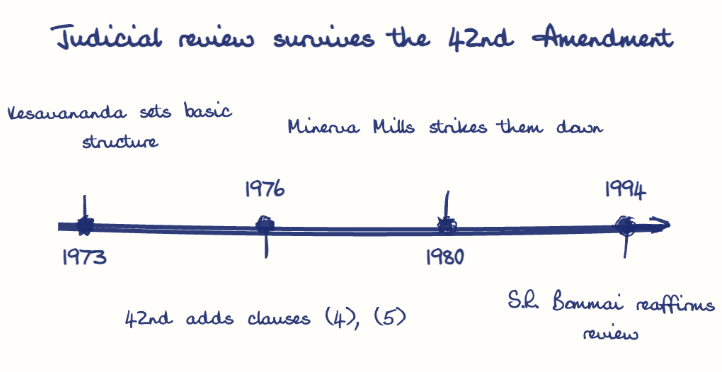
Clauses (4) and (5), added to Article 368 by the 1976 42nd Amendment, sought to bar courts from questioning amendments, but they did not prevent judicial review. In Minerva Mills (1980) the Supreme Court struck them down, holding judicial review part of the basic structure set out in Kesavananda Bharati.
Model answer
Ghissu Editorial · Verified 4 Oct 2026 · 262 words
Basic Structure Doctrine
Kesavananda Bharati v. State of Kerala3 (1973) held that judicial review is part of the Constitution’s basic structure, limiting Parliament’s amending power. This doctrine protects essential features like fundamental rights and judicial review itself, preventing Parliament from altering the Constitution’s core framework.
Judicial Reversal of Clauses
Minerva Mills Ltd. v. Union of India (1980) invalidated clauses (4) and (5), reaffirming judicial review’s indispensability as part of the basic structure. The Court emphasized that Parliament cannot abrogate judicial review, restoring the constitutional balance disrupted by the 42nd Amendment.
Judicial Review’s Practical Role
Subsequent rulings like S.R. Bommai v. Union of India (1994) and I.R. Coelho v. State of Tamil Nadu (2007) demonstrate judicial review’s continued role in safeguarding constitutionalism. The NJAC case (2015), which struck down the 99th Amendment, underscores that amendments remain subject to judicial scrutiny.
Strengthening Institutions
Enhancing judicial independence through transparent appointments and adequate resources, alongside promoting constitutional literacy among legislators and citizens, can prevent future attempts to bypass judicial review.
This model answer is indicative and the model can make mistakes; please verify key facts independently.
Practise this question
1Get the answer sheet
Sized for this question.
2Write your answer
Timed, by hand.
3Get it marked
Your score and what to fix.
This chapter in the exam
Judiciary: courts, judicial review, activism, independence2 questions
Asked in 2 of 2 sittings since 2016
Most tested: Judicial independence in the higher judiciary, especially appointment and the scope of judicial review over constitutional change.
Question from the official TGPSC Group-I Mains 2016 paper. Answer written by Ghissu's engine and checked against our editorial standards. Found an error? Tell us and we correct it within 48 hours.