Discuss the constitutional provisions regarding State formation. Is a constitutional amendment necessary to bring a new State into existence?
In short
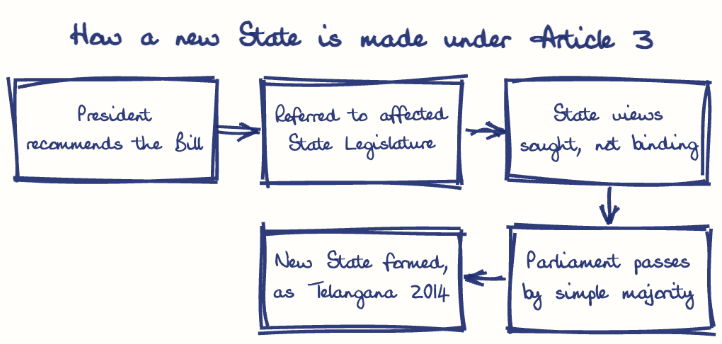
Article 3 lets Parliament form new States or alter boundaries and names by ordinary law, on the President's recommendation, after seeking the non-binding views of the affected State Legislature. No constitutional amendment is needed because Article 4 excludes such laws from Article 368, as Telangana's 2014 creation showed.
Model answer
Ghissu Editorial · Verified 4 Oct 2026 · 267 words
Article 3’s Legislative Power
Parliament can create or alter States by separating or uniting territories without needing State consent, as demonstrated by the Andhra Pradesh Reorganisation Act, 2014. This power underscores the supremacy of the Union in territorial matters and allows flexibility in responding to socio-political demands.
Role of President and State Legislatures
Bills under Article 3 require the President’s recommendation and referral to State Legislatures for their views within a specified period. However, Parliament may disregard these views, as seen in the opposition from the Andhra Pradesh Legislative Assembly during Telangana’s formation, emphasizing Parliament’s overriding authority.
No Amendment Required
The Supreme Court clarified that internal State reorganization under Article 3 is not a constitutional amendment, unlike territorial cession which requires one, as established in the Berubari Union case. This distinction affirms that State formation is a legislative process, not an amendment procedure.
Judicial and Public Role
Develop clearer judicial guidelines to resolve disputes and encourage public participation through referendums or consultations, thereby legitimizing the process and reducing conflicts.
This model answer is indicative and the model can make mistakes; please verify key facts independently.
Practise this question
1Get the answer sheet
Sized for this question.
2Write your answer
Timed, by hand.
3Get it marked
Your score and what to fix.
This chapter in the exam
Federalism, Centre-State relations, local government, inter-state disputes4 questions
Asked in 2 of 2 sittings since 2016
Most tested: 73rd and 74th Constitutional Amendments and their implementation/effectiveness
- 2024Examine how the 73rd and 74th Constitutional Amendment Acts have strengthened democratic decentralization in India.
- 2024Evaluate the role of the Finance Commission in maintaining fiscal federalism in India.
All 4 questions, sorted by sub-topic, with model answers and practice.
Question from the official TGPSC Group-I Mains 2016 paper. Answer written by Ghissu's engine and checked against our editorial standards. Found an error? Tell us and we correct it within 48 hours.