Evaluate the role of the Finance Commission in maintaining fiscal federalism in India.
In short
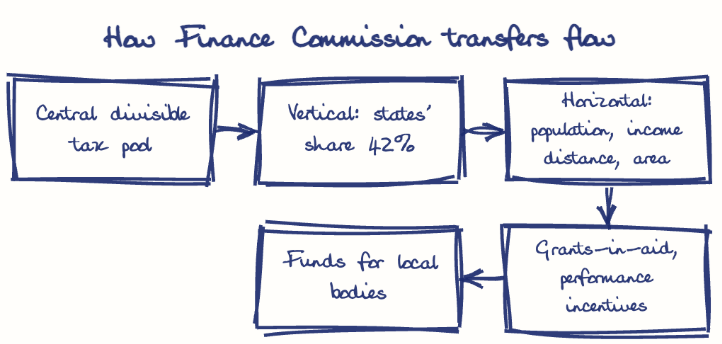
The Finance Commission under Article 280 sustains fiscal federalism by recommending, every five years, how central taxes are shared with and among states, plus grants to states and local bodies. The Fourteenth Finance Commission raised states' share from 32% to 42%, though its 2011 Census criteria draw criticism.
Model answer
Ghissu Editorial · Verified 4 Oct 2026 · 266 words
Constitutional Mandate and Advisory Role
Constituted every five years, the Commission recommends tax devolution and grants; its advisory recommendations are generally accepted, preserving fiscal balance.
Expanded Terms of Reference
Beyond tax sharing, it recommends grants-in-aid, performance incentives, and local government finance augmentation, reflecting its evolving role in cooperative federalism.
Vertical and Horizontal Equity
The FFC’s increase in states’ tax share addresses vertical imbalances; criteria like population and income distance ensure horizontal equity, benefiting diverse states including Telangana.
Grants and Local Government Support
Grants-in-aid and performance-based incentives promote fiscal discipline; support for local bodies aligns with 73rd and 74th Amendments, aiding gram panchayats and municipalities in Telangana.
Enhancing State Autonomy
Increased tax shares and performance grants have improved states’ fiscal autonomy and social sector investments, as seen in Telangana’s budget allocations.
Challenges of Data and Enforcement
Reliance on 2011 census data raises fairness concerns; as an advisory body, the Commission’s recommendations can be overridden, though this is rare.
This model answer is indicative and the model can make mistakes; please verify key facts independently.
Practise this question
1Get the answer sheet
Sized for this question.
2Write your answer
Timed, by hand.
3Get it marked
Your score and what to fix.
This chapter in the exam
Federalism, Centre-State relations, local government, inter-state disputes4 questions
Asked in 2 of 2 sittings since 2016
Most tested: 73rd and 74th Constitutional Amendments and their implementation/effectiveness
- 2024Examine how the 73rd and 74th Constitutional Amendment Acts have strengthened democratic decentralization in India.
- 2016Discuss the constitutional provisions regarding State formation. Is a constitutional amendment necessary to bring a new State into existence?
All 4 questions, sorted by sub-topic, with model answers and practice.
Question from the official TGPSC Group-I Mains 2024 paper. Answer written by Ghissu's engine and checked against our editorial standards. Found an error? Tell us and we correct it within 48 hours.