Examine how the 73rd and 74th Constitutional Amendment Acts have strengthened democratic decentralization in India.
In short
The 73rd and 74th Amendments (1992) gave Panchayats and Municipalities constitutional status, five-yearly elections under State Election Commissions and reserved seats for SCs, STs and at least one-third for women. Women now hold close to half of Panchayat seats, but weak devolution of funds and elite capture limit the gains.
Model answer
Ghissu Editorial · Verified 4 Oct 2026 · 244 words
Constitutional Status and Structure
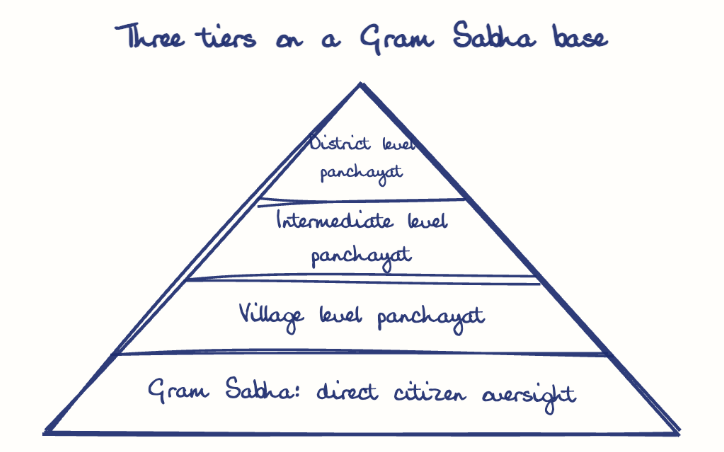
The 73rd Amendment introduced a three-tier Panchayati Raj system (village, intermediate, district), while the 74th Amendment recognized Municipalities, both with constitutional continuity.
Reservation and Elections
Both Acts mandate reservation for Scheduled Castes, Scheduled Tribes, and at least one-third women, with regular elections every five years supervised by independent State Election Commissions.
Empowerment and Inclusion
The amendments have increased political participation and social inclusion; women now make up close to half of Panchayat representatives, reflecting significant gender empowerment.
Decentralized Planning and Accountability
Panchayats and Municipalities prepare local development plans under the Eleventh and Twelfth Schedules; Gram Sabhas enhance transparency and citizen oversight.
Limited Devolution and Elite Capture
Many states have not fully devolved powers or finances; local elites often dominate governance, undermining democratic decentralization.
Capacity and Election Issues
Delays in elections and lack of training for elected representatives, especially women and marginalized groups, hinder effective governance.
Strengthen Devolution
Full transfer of functions, finances, and functionaries as per the Eleventh and Twelfth Schedules is essential.
Capacity Building
Institutionalized training programs for elected representatives must be prioritized.
This model answer is indicative and the model can make mistakes; please verify key facts independently.
Sources
Practise this question
1Get the answer sheet
Sized for this question.
2Write your answer
Timed, by hand.
3Get it marked
Your score and what to fix.
This chapter in the exam
Federalism, Centre-State relations, local government, inter-state disputes4 questions
Asked in 2 of 2 sittings since 2016
Most tested: 73rd and 74th Constitutional Amendments and their implementation/effectiveness
- 2024Evaluate the role of the Finance Commission in maintaining fiscal federalism in India.
- 2016Discuss the constitutional provisions regarding State formation. Is a constitutional amendment necessary to bring a new State into existence?
All 4 questions, sorted by sub-topic, with model answers and practice.
Question from the official TGPSC Group-I Mains 2024 paper. Answer written by Ghissu's engine and checked against our editorial standards. Found an error? Tell us and we correct it within 48 hours.