"Administration of public health has deteriorated in the last three decades". Examine the statement and explain the social consequences.
In short
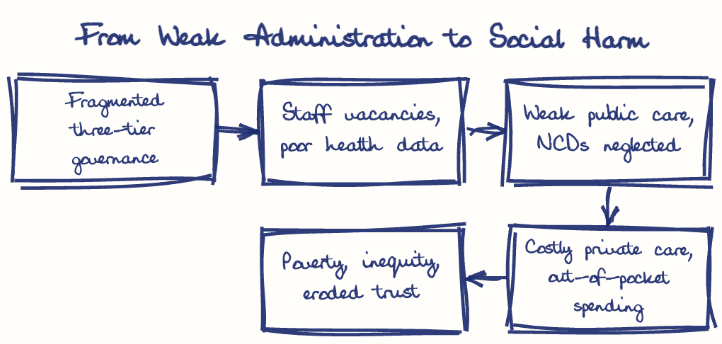
Public health administration has weakened through fragmented governance, chronic staff vacancies, poor data and neglect of non-communicable diseases, as COVID-19 exposed. The social consequences are wider health inequities, high out-of-pocket spending that pushes poor households into poverty, falling trust in public hospitals and worsening urban health.
Model answer
Ghissu Editorial · Verified 4 Oct 2026 · 258 words
Infrastructure and Workforce Deficits
Maharashtra’s public sector hospitals face 61% vacancies in rural specialist posts, reflecting chronic underinvestment and poor human resource management that weaken frontline health services.
Administrative Gaps and Fragmented Governance
Many health commissions operate without chiefs or adequate staff, lacking transparency and accountability. The complex three-tier governance involving central, state, and urban local bodies leads to coordination failures, especially in rapidly urbanising areas.
Health Inequities and Access Barriers
NFHS-61 data shows health improvements but persistent social inequalities, with marginalized groups in slums and rural areas facing poor access and high disease burden, exacerbating undernutrition and morbidity.
Strengthen Decentralised Governance
Empower urban local bodies with clear mandates and adequate resources, as demonstrated in Hyderabad, to improve coordination and responsiveness amid rapid urbanisation and slum proliferation.
Modernise Data Systems and Expand Workforce
Invest in digital health infrastructure for real-time monitoring and evidence-based policymaking, while implementing targeted recruitment and retention strategies under schemes like the National Health Mission to address workforce shortages in underserved areas.
This model answer is indicative and the model can make mistakes; please verify key facts independently.
Practise this question
1Get the answer sheet
Sized for this question.
2Write your answer
Timed, by hand.
3Get it marked
Your score and what to fix.
This chapter in the exam
Human resources, demography, education and health3 questions
Asked in 2 of 2 sittings since 2016
Most tested: Demographic structure and transition of Telangana using census indicators.
- 2024"The demographic structure and transition of Telangana deviated from the demographic structure and transition of India during 1961-2011" (as per census data). Examine with reference to sex ratio, rural-urban population, literacy and decadal growth rate of population.
- 2016Critically appraise privatization of education in the State of Andhra Pradesh.
Question from the official TGPSC Group-I Mains 2016 paper. Answer written by Ghissu's engine and checked against our editorial standards. Found an error? Tell us and we correct it within 48 hours.