Critically appraise privatization of education in the State of Andhra Pradesh.
In short
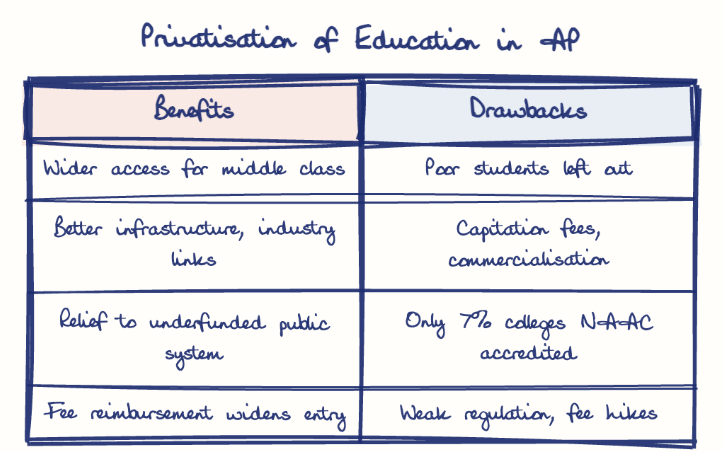
Privatisation of education in Andhra Pradesh has widened access through private junior and engineering colleges, but it has raised serious concerns over quality, equity, commercialisation and weak regulation. A CAG audit found only 7% of affiliated colleges NAAC accredited in 2018-19, and fee reimbursement has become a heavy fiscal burden.
Model answer
Ghissu Editorial · Verified 4 Oct 2026 · 244 words
Access Expansion
Private schools and colleges have grown rapidly, increasing enrollment in urban and semi-urban areas and meeting middle-class demand.
Quality Deficits
A 2018-19 CAG audit found only 7% of private colleges NAAC accredited, highlighting widespread quality concerns.
Equity Challenges
Despite quotas, poorer students often cannot afford private education, worsening educational stratification.
Fiscal Strain
The state’s fee reimbursement scheme for SC, ST, and OBC students imposes a heavy fiscal burden and causes delays affecting private institutions.
Innovation and Infrastructure
Private institutions bring better facilities and industry linkages, enhancing employability.
Commercialization Risks
Profit-driven motives lead to capitation fees and compromised standards.
Public System Relief
Privatization reduces pressure on underfunded government schools, allowing targeted welfare schemes.
Regulatory Gaps
Andhra Pradesh struggles with regulating fee hikes and transparency, undermining privatization benefits.
Strengthen Regulation
Empower oversight bodies to enforce quality and fee transparency.
Boost Public Investment
Increase education spending to 6% of GSDP to improve government schools.
Reform Fee Reimbursement
Ensure timely payments linked to quality and equity.
Promote Inclusive Models
Foster public-private partnerships focusing on marginalized communities.
This model answer is indicative and the model can make mistakes; please verify key facts independently.
Practise this question
1Get the answer sheet
Sized for this question.
2Write your answer
Timed, by hand.
3Get it marked
Your score and what to fix.
This chapter in the exam
Human resources, demography, education and health3 questions
Asked in 2 of 2 sittings since 2016
Most tested: Demographic structure and transition of Telangana using census indicators.
- 2024"The demographic structure and transition of Telangana deviated from the demographic structure and transition of India during 1961-2011" (as per census data). Examine with reference to sex ratio, rural-urban population, literacy and decadal growth rate of population.
- 2016"Administration of public health has deteriorated in the last three decades". Examine the statement and explain the social consequences.
Question from the official TGPSC Group-I Mains 2016 paper. Answer written by Ghissu's engine and checked against our editorial standards. Found an error? Tell us and we correct it within 48 hours.