Critically appraise the objectives and major achievements in Indian economy during the Planning era during 1950-91.
In short
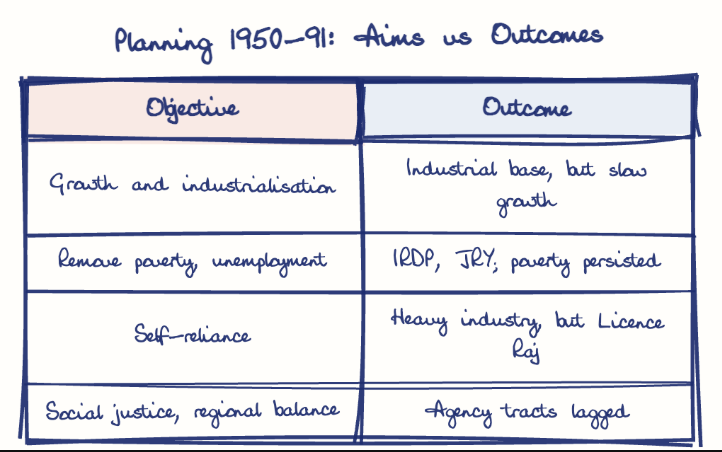
The Planning era (1950-91) aimed at growth, poverty removal, self-reliance and social justice, and built India's industrial, institutional and agricultural foundations, including foodgrain self-sufficiency through the Green Revolution. Yet the Licence Raj, slow growth, persistent poverty and uneven regional development limited its gains, setting the stage for the 1991 reforms.
Model answer
Ghissu Editorial · Verified 4 Oct 2026 · 240 words
Sustained Growth and Industrial Base
The Sixth Five Year Plan emphasised high growth to modernise the economy. Public sector enterprises and infrastructure projects like Telangana’s Ramagundam power complex laid the foundation for industrialisation and energy security, supporting heavy industries and small-scale sectors.
Institutional Development and Macroeconomic Stability
The Planning Commission institutionalised economic policymaking through Five-Year Plans1. Despite crises like the 1960s food shortages and wars, India maintained macroeconomic stability, setting the stage for future reforms.
Mixed Success and Persistent Challenges
Growth rates were often below targets; bureaucratic controls and the Licence Raj stifled private enterprise and innovation. Poverty and unemployment remained high, especially in the rain-fed Deccan interior of Telangana, due to structural and skill mismatches.
Focused Regional Development and Employment
Strengthen targeted schemes like Mission Bhagiratha to improve water access in drought-prone areas. Promote employment-intensive sectors such as MSMEs and agro-industries to generate rural jobs and reduce regional disparities2.
This model answer is indicative and the model can make mistakes; please verify key facts independently.
Practise this question
1Get the answer sheet
Sized for this question.
2Write your answer
Timed, by hand.
3Get it marked
Your score and what to fix.
This chapter in the exam
Planning, NITI Aayog, liberalisation5 questions
Asked in 2 of 2 sittings since 2016
Most tested: Planning era performance and the shift from Planning Commission to NITI Aayog
- 2024How far has India achieved the policy target of doubling the farmers' income by 2022? Examine.
- 2024"Replacement of the Planning Commission by NITI Aayog has changed the approach to development planning in India." Explain.
All 5 questions, sorted by sub-topic, with model answers and practice.
Question from the official TGPSC Group-I Mains 2016 paper. Answer written by Ghissu's engine and checked against our editorial standards. Found an error? Tell us and we correct it within 48 hours.