Critically examine the water laws in India and suggest measures for progressive reforms.
In short
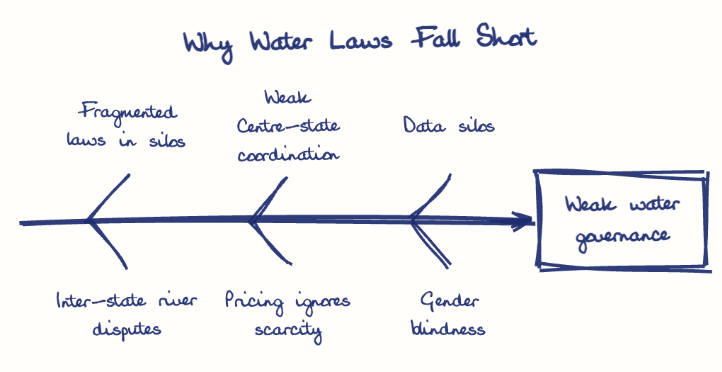
India's water laws are fragmented, weakly enforced, data-poor and blind to equity and gender, and since water is a state subject, inter-state disputes over rivers like the Godavari and Krishna drag on. Reform needs a unified national water law, basin-level organisations with data sharing, gender-sensitive governance and rational pricing.
Model answer
Ghissu Editorial · Verified 4 Oct 2026 · 271 words
Fragmented Legal Framework
Laws such as the Environment (Protection) Act and Water (Prevention and Control of Pollution) Act function in silos without a unified national water law, causing overlapping jurisdictions.
State-Centric Constitutional Mandate
Water as a state subject complicates inter-state dispute resolution, exemplified by prolonged litigation over the Godavari and Krishna rivers involving Telangana.
Legal Provisions vs. Enforcement
Acts like the Water (Prevention and Control of Pollution) Act provide regulatory basis, but enforcement is weak; groundwater data in Telangana is limited, impeding sustainable management.
Social and Gender Blindness
Current laws inadequately address gender and social equity, limiting women’s participation in water governance, especially in rural Telangana.
Comprehensive National Water Law
Enact a unified law integrating surface and groundwater management, clarifying roles of Centre, states, and local bodies.
Basin-Level Governance and Data Sharing
Establish river basin organizations with all riparian states, including Telangana, supported by transparent data systems.
Social Equity and Gender Inclusion
Mainstream gender in water governance to enhance women’s roles and access, particularly in rural and tribal areas.
Water Pricing and Conservation Incentives
Implement rational pricing and promote water-efficient technologies, supported by schemes like PMKSY in Telangana.
This model answer is indicative and the model can make mistakes; please verify key facts independently.
Practise this question
1Get the answer sheet
Sized for this question.
2Write your answer
Timed, by hand.
3Get it marked
Your score and what to fix.
This chapter in the exam
Natural resources: forests, water, land, mining3 questions
Asked in 2 of 2 sittings since 2016
Most tested: Policy and legal reform in resource management, especially water/land governance.
Question from the official TGPSC Group-I Mains 2016 paper. Answer written by Ghissu's engine and checked against our editorial standards. Found an error? Tell us and we correct it within 48 hours.