Assess the effectiveness policies in India for land resources management.
In short
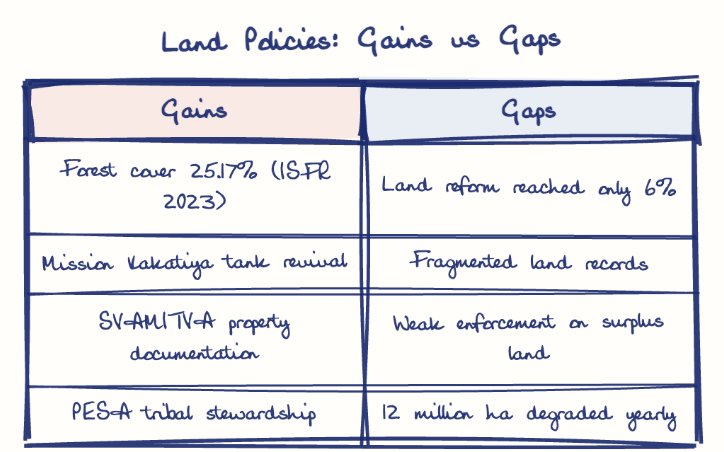
India's land resource policies are only partly effective: legal frameworks and afforestation have raised forest and tree cover to 25.17% (ISFR 2023), but land reforms and urban land governance lag. Only about 6% of operated land benefited from redistribution or tenancy reform, and about 12 million hectares degrade annually.
Model answer
Ghissu Editorial · Verified 4 Oct 2026 · 231 words
Limited Land Reform Success
Despite decades of reforms, only 6% of agricultural land has been redistributed or reformed, indicating persistent land inequality and productivity issues.
Urban Land Use Issues in Telangana
Telangana’s urban local bodies’ poor solid waste management and water tap coverage (9.74%5-55.69% under AMRUT) highlight governance weaknesses.
Effective State Initiatives
Mission Kakatiya in Telangana restored water bodies, enhancing agricultural productivity and land use efficiency.
Weak Land Records and Enforcement
Fragmented land records and slow enforcement hinder transparency and dispute resolution, despite digital efforts like SVAMITVA.
Sustainable Land Use Challenges
Land degradation causes loss of 12 million hectares annually; renewable energy projects sometimes harm grasslands and livelihoods.
Policy Recommendations
Strengthen digital land records (SVAMITVA), improve urban governance under AMRUT and Smart Cities, and scale up agroforestry policies in Telangana for balanced development and conservation.
This model answer is indicative and the model can make mistakes; please verify key facts independently.
Practise this question
1Get the answer sheet
Sized for this question.
2Write your answer
Timed, by hand.
3Get it marked
Your score and what to fix.
This chapter in the exam
Natural resources: forests, water, land, mining3 questions
Asked in 2 of 2 sittings since 2016
Most tested: Policy and legal reform in resource management, especially water/land governance.
Question from the official TGPSC Group-I Mains 2024 paper. Answer written by Ghissu's engine and checked against our editorial standards. Found an error? Tell us and we correct it within 48 hours.