Discuss the salient features of the Integrated Watershed Management Programme.
In short
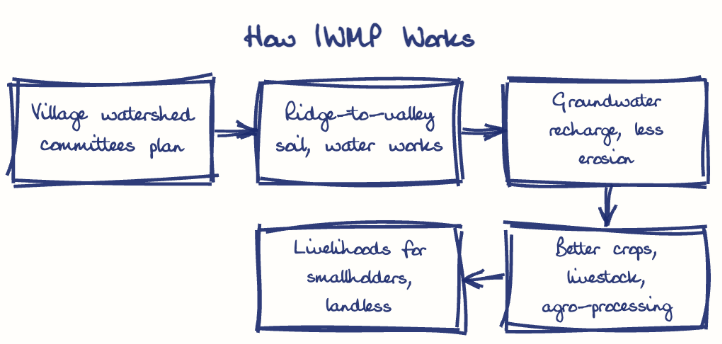
The Integrated Watershed Management Programme (2009-10) merged DPAP, DDP and IWDP into one scheme that treats watersheds as hydrological units on a ridge-to-valley basis, with village watershed committees and livelihood components. It improves groundwater recharge, soil fertility and productivity, though benefits often skew towards landed farmers.
Model answer
Ghissu Editorial · Verified 4 Oct 2026 · 263 words
Unified Scheme Integration
IWMP merges DPAP, DDP, and IWDP under 2011 guidelines, enabling coordinated planning across hydrological units rather than administrative boundaries.
Community Involvement
Formation of village watershed committees and capacity building, including women’s participation, ensures equitable and sustainable management; Telangana demonstrates effective panchayati raj involvement.
Multi-Agency Collaboration
Government, NGOs, and technical agencies like WAPCOS Ltd implement IWMP, with ISRO’s geo-tagging enhancing transparency.
Biophysical and Livelihood Integration
IWMP combines soil-water conservation with livelihood activities, benefiting smallholders and landless households.
Equity and Demand-Side Gaps
Benefits skew towards landed farmers; insufficient focus on water use regulation and biomass sustainability limits impact.
Political Constraints
Long project cycles clash with electoral terms, leading to preference for quick fixes, e.g., Maharashtra’s Jalyukt Shivar.
Positive Impacts
IWMP improves groundwater recharge, reduces erosion, and boosts productivity, complementing Telangana’s Mission Kakatiya and Kaleshwaram.
Community Empowerment
Greater financial autonomy and inclusion of marginalised groups in watershed committees can enhance equity.
Integrated Management and Technology
Combining demand-supply water management and expanding geo-tagging will improve sustainability and monitoring.
Policy Continuity
Political commitment beyond electoral cycles and capacity building are essential for long-term success.
This model answer is indicative and the model can make mistakes; please verify key facts independently.
Practise this question
1Get the answer sheet
Sized for this question.
2Write your answer
Timed, by hand.
3Get it marked
Your score and what to fix.
This chapter in the exam
Natural resources: forests, water, land, mining3 questions
Asked in 2 of 2 sittings since 2016
Most tested: Policy and legal reform in resource management, especially water/land governance.
Question from the official TGPSC Group-I Mains 2016 paper. Answer written by Ghissu's engine and checked against our editorial standards. Found an error? Tell us and we correct it within 48 hours.