Explain the socio-economic basis for land reform policy. Appraise the implementation of land reforms in the State of Andhra Pradesh.
In short
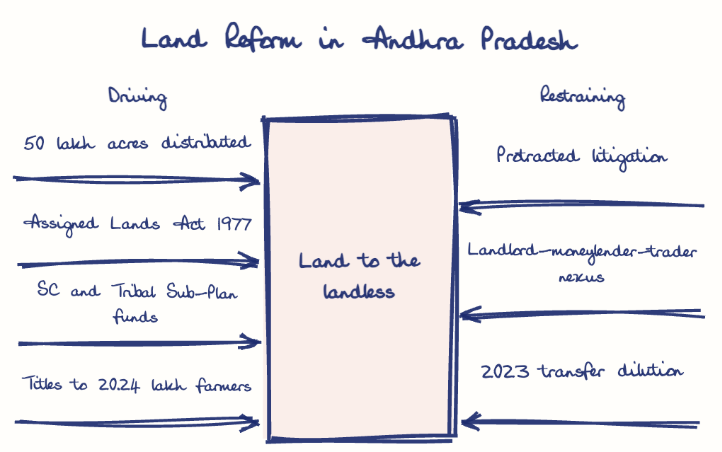
Land reform rests on equity, poverty reduction, productivity and social justice for SCs and STs, and Andhra Pradesh was an early reformer, distributing around 50 lakh acres. Legal loopholes, litigation and the landlord nexus slowed it, and the 2023 relaxation of the Assigned Lands Act drew allegations of misuse.
Model answer
Ghissu Editorial · Verified 4 Oct 2026 · 259 words
Land reform in Andhra Pradesh addresses rural poverty, inequality, and agricultural productivity by redistributing land to marginalized groups, supported by constitutional and legal frameworks such as the Andhra Pradesh Assigned Lands (Prohibition of Transfers) Act, 1977.
Socio-Economic Basis
1. Equity and Social Justice: Land reforms target Scheduled Castes and Tribes, supported by Article 338 and schemes like the Andhra Pradesh Scheduled Castes Sub-Plan and Tribal Sub-Plan, ensuring land access and empowerment of historically disadvantaged groups.
Early Success and Title Distribution
Andhra Pradesh was an early reformer, distributing about 50 lakh acres to the underprivileged, contributing to a marked decline in poverty. Recent efforts granted ownership titles to over 20.24 lakh farmers covering 35.45 lakh acres, including long-term assignees, formalizing land rights and empowering cultivators.
Challenges and Controversies
Legal loopholes, landlord influence, and protracted litigation have hindered reforms. The 2023 amendments to the Assigned Lands Act relaxed transfer restrictions, leading to corruption allegations involving government officials acquiring lands originally assigned to Dalits, threatening social justice and undermining reform objectives.
Transparency and Support
Implement robust digital land record systems with community participation to prevent fraudulent transactions, and complement reforms with schemes like Annadatha Sukhibhava to provide financial and technical support to marginal farmers.
This model answer is indicative and the model can make mistakes; please verify key facts independently.
Practise this question
1Get the answer sheet
Sized for this question.
2Write your answer
Timed, by hand.
3Get it marked
Your score and what to fix.
This chapter in the exam
Land reforms3 questions
Asked in 2 of 2 sittings since 2016
Most tested: Redistribution to agricultural labourers and the landless poor, with critical appraisal of implementation/outcomes.
Question from the official TGPSC Group-I Mains 2016 paper. Answer written by Ghissu's engine and checked against our editorial standards. Found an error? Tell us and we correct it within 48 hours.