How can one justify state acquiring land from its citizens? Critically appraise the changes in the policy of compensation.
In short
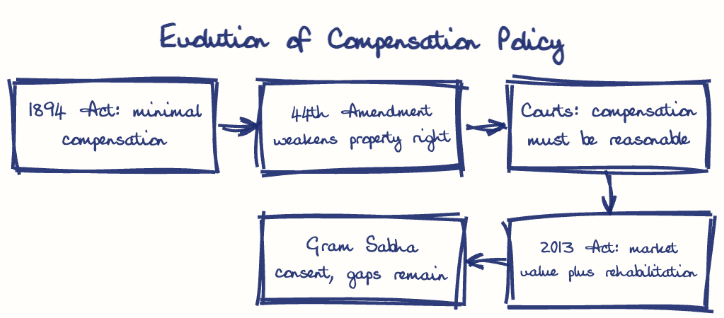
The state may acquire land under eminent domain for genuine public purposes like dams and roads, as Article 300A permits deprivation of property by law. Compensation shifted from the 1894 Act's minimal payouts to market-based compensation, rehabilitation and Gram Sabha consent under the 2013 Act, though delays persist.
Model answer
Ghissu Editorial · Verified 4 Oct 2026 · 255 words
Eminent Domain and Public Purpose
The doctrine of eminent domain allows acquisition for infrastructure like dams and roads essential for growth.
Constitutional Backing and Legal Precedents
Article 300A permits acquisition only for public purpose, upheld in K.T. Plantation Private Ltd vs State of Karnataka.
Social Justice and Vulnerable Groups
Acquisition impacts marginalized communities, necessitating inclusive policies to protect landless laborers and tribals, especially in Telangana.
From Arbitrary to Fair Compensation
The 2013 Right to Fair Compensation and Transparency Act mandates market-value compensation and rehabilitation, replacing the outdated 1894 Act.
Judicial Reinforcement
Supreme Court rulings like Thakur Kuldeep Singh vs Union of India emphasize reasonable compensation reflecting market conditions.
Implementation Gaps
Delays and inadequate compensation persist, causing distress migration and dispossession of marginalized groups, notably in Telangana.
Gram Sabha Consent and Democracy
While the 2013 Act requires Gram Sabha consent, coercion undermines grassroots democracy, as seen in resistance movements in Telangana.
Market-Linked Compensation and Transparency
Ensure real-time market valuation with e-governance tracking.
Rehabilitation and Livelihood Restoration
Prioritize vulnerable groups with skill training and land-for-land options.
Empower Gram Sabhas
Legally mandate consent with grievance redressal to prevent coercion.
This model answer is indicative and the model can make mistakes; please verify key facts independently.
Practise this question
1Get the answer sheet
Sized for this question.
2Write your answer
Timed, by hand.
3Get it marked
Your score and what to fix.
This chapter in the exam
Land reforms3 questions
Asked in 2 of 2 sittings since 2016
Most tested: Redistribution to agricultural labourers and the landless poor, with critical appraisal of implementation/outcomes.
Question from the official TGPSC Group-I Mains 2016 paper. Answer written by Ghissu's engine and checked against our editorial standards. Found an error? Tell us and we correct it within 48 hours.