"The land reforms in Telangana were aimed at redistributing the land from large farmers to agricultural labourers and landless poor." Critically evaluate.
In short
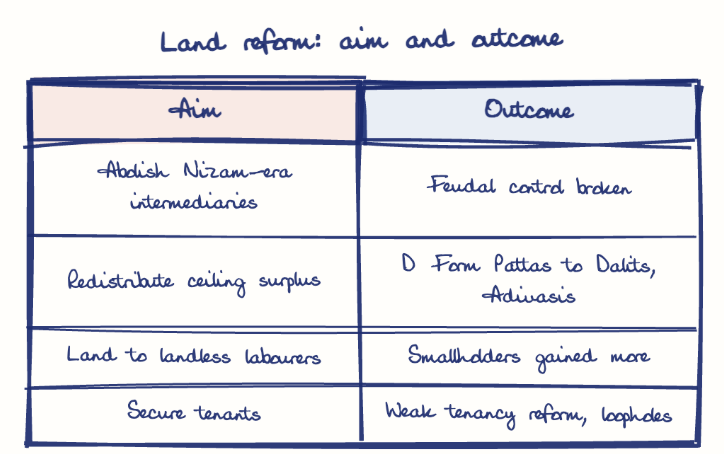
Telangana's land reforms broke feudal landlord control through abolition of intermediaries, ceilings and assignment of D Form Patta lands to Dalits and Adivasis, but they reached landless labourers only partly. Loopholes, manipulated records, benami alienation and fragmentation limited results, and the 2014 three-acre scheme for Dalit families had modest coverage.
Model answer
Ghissu Editorial · Verified 4 Oct 2026 · 303 words
Abolition of Zamindari and Land Ceiling
Reforms abolished intermediaries and imposed land ceilings, redistributing surplus land to Dalits and Adivasis via D Form Patta assignments. This direct state-cultivator relationship was crucial in breaking landlord dominance.
Titles to Marginalised Groups
Assigned land pattas and the 2014 scheme of three acres for landless Dalit women's families gave titles to Dalits and Adivasis, strengthening tenure security, though landless labourers as a whole gained only partly.
Administrative Hurdles
Slow updating of land records, disputes over titles and illegal alienation of assigned lands continue to delay benefits reaching the truly landless.
Need for Complementary Reforms
Consolidation, mechanisation, and market access remain weak, limiting smallholder viability. Without these, fragmented holdings struggle to achieve economies of scale and sustainable growth.
This model answer is indicative and the model can make mistakes; please verify key facts independently.
Practise this question
1Get the answer sheet
Sized for this question.
2Write your answer
Timed, by hand.
3Get it marked
Your score and what to fix.
This chapter in the exam
Land reforms3 questions
Asked in 2 of 2 sittings since 2016
Most tested: Redistribution to agricultural labourers and the landless poor, with critical appraisal of implementation/outcomes.
Question from the official TGPSC Group-I Mains 2024 paper. Answer written by Ghissu's engine and checked against our editorial standards. Found an error? Tell us and we correct it within 48 hours.