Public sector performance deteriorated more due to administrative policies of the state rather than any other reason. Defend this statement with the help of examples.
In short
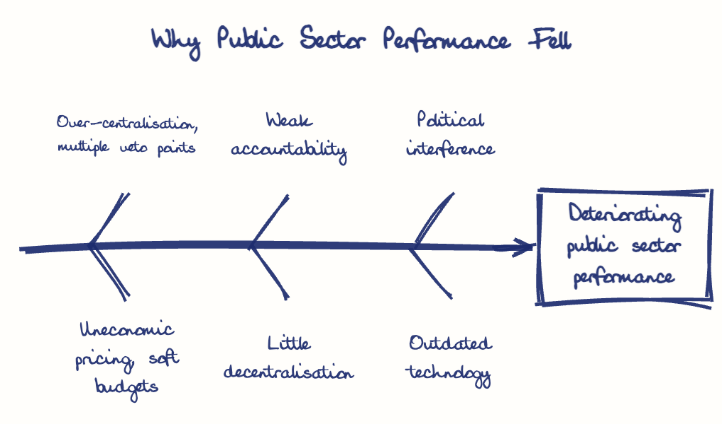
Public sector decline stems mainly from state administrative policy: over-centralisation, uneconomic pricing and soft budgets, and procedure over accountability, while even political interference and market factors work through these choices. The 2023 CAG report on Telangana's SPSEs links their losses to delayed audits, weak oversight and poor transparency.
Model answer
Ghissu Editorial · Verified 4 Oct 2026 · 277 words
Over-centralization and Bureaucratic Rigidities
The Second Administrative Reforms Commission highlights how centralized control and multiple veto points delay PSU decisions and reduce managerial autonomy. This excessive hierarchy causes inordinate delays and cost escalations, undermining efficiency.
Technological Deficits and Market Environment
Outdated technology and limited competition reduce PSU competitiveness, though these are influenced by administrative policies. Market failures and regulatory constraints also shield PSUs from necessary reforms.
CAG 2026 Audit
Reveals persistent governance gaps in Central PSUs, including inadequate independent directors and accounting deviations, underscoring systemic administrative weaknesses.
Digital Public Infrastructure4 Reforms
Initiatives like Aadhaar and DBT show how administrative reforms focused on transparency, accountability, and technology can significantly improve public service delivery and efficiency.
Decentralize Decision-Making
Empower local bodies and frontline managers with autonomy and resources to improve responsiveness and reduce delays in service delivery.
Strengthen Performance Management
Institutionalize robust monitoring, accountability mechanisms, and reward systems to foster a culture of results-oriented governance.
This model answer is indicative and the model can make mistakes; please verify key facts independently.
Practise this question
1Get the answer sheet
Sized for this question.
2Write your answer
Timed, by hand.
3Get it marked
Your score and what to fix.
This chapter in the exam
Planning, NITI Aayog, liberalisation5 questions
Asked in 2 of 2 sittings since 2016
Most tested: Planning era performance and the shift from Planning Commission to NITI Aayog
- 2024How far has India achieved the policy target of doubling the farmers' income by 2022? Examine.
- 2024"Replacement of the Planning Commission by NITI Aayog has changed the approach to development planning in India." Explain.
All 5 questions, sorted by sub-topic, with model answers and practice.
Question from the official TGPSC Group-I Mains 2016 paper. Answer written by Ghissu's engine and checked against our editorial standards. Found an error? Tell us and we correct it within 48 hours.