"The Central Bank autonomy is important for conducting a consistent monetary policy" Comment.
In short
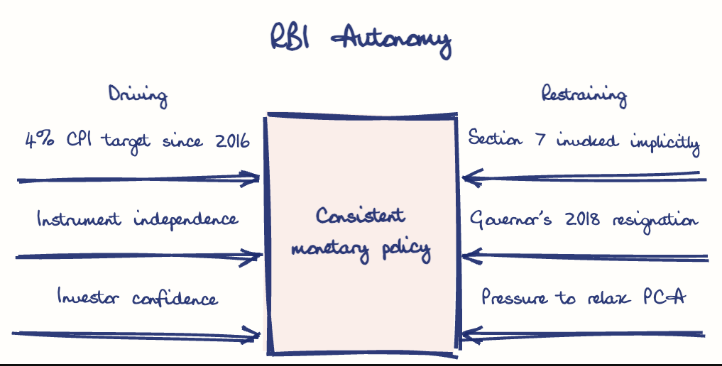
Central bank autonomy lets the RBI balance inflation control with growth free of short-term political pressure, making monetary policy predictable and credible. Its instrument independence under the 4% CPI target (plus or minus 2%) adopted in 2016 has largely contained inflation, while the 2018 clashes showed the risks of interference.
Model answer
Ghissu Editorial · Verified 4 Oct 2026 · 273 words
Instrument Independence Ensures Credibility
RBI’s ability to set monetary tools helped maintain the 4% CPI inflation target (±2%) since 2016, crucial for macroeconomic stability and investor confidence.
Legal and Political Challenges
The government’s implicit use of Section 7 of the RBI Act and leadership changes, like Governor Urjit Patel’s 2018 resignation, highlight political interference1 risks undermining RBI’s autonomy and its capacity to regulate credit and liquidity effectively.
RBI’s Steady Monetary Policy
Despite political pressures, the RBI and its Monetary Policy Committee largely kept inflation within the target band, supporting stable credit flow vital for Telangana’s agriculture and industry sectors.
Risks to Banking Regulation and Growth
Political pressure to ease credit and relax the Prompt Corrective Action (PCA) framework threatens RBI’s regulatory role, impacting schemes like Rythu Bandhu in Telangana and investor confidence in Hyderabad’s IT and pharmaceutical sectors.
Legislative Safeguards and Transparency
Enacting clear autonomy provisions and enhancing RBI’s communication can reduce political friction and build public trust, especially in states like Telangana with diverse economic interests.
Cooperative Federalism for Inclusive Growth
Aligning RBI, central, and Telangana state policies ensures monetary policy supports regional development priorities and inclusive growth.
This model answer is indicative and the model can make mistakes; please verify key facts independently.
Practise this question
1Get the answer sheet
Sized for this question.
2Write your answer
Timed, by hand.
3Get it marked
Your score and what to fix.
This chapter in the exam
Money and banking4 questions
Asked in 2 of 2 sittings since 2016
Most tested: RBI-led monetary policy and liquidity management
- 2024What changes have been introduced in money supply measures as per the recommendations of the Working Group on Money Supply, 1998 chaired by Dr. Y.V. Reddy?
- 2024Analyse briefly how Liquidity Adjustment Facility (LAF) in India emerged as an effective monetary policy instrument to control market fluctuations in the short run.
All 4 questions, sorted by sub-topic, with model answers and practice.
Question from the official TGPSC Group-I Mains 2016 paper. Answer written by Ghissu's engine and checked against our editorial standards. Found an error? Tell us and we correct it within 48 hours.