Analyse briefly how Liquidity Adjustment Facility (LAF) in India emerged as an effective monetary policy instrument to control market fluctuations in the short run.
In short
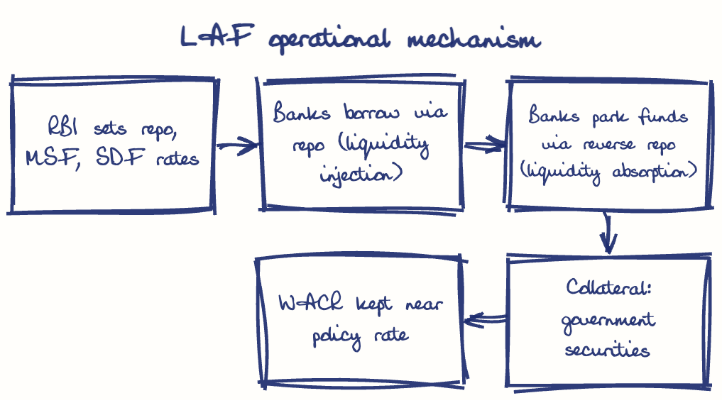
The Liquidity Adjustment Facility lets the RBI inject or absorb liquidity daily through repos, reverse repos and standing facilities, keeping short-term rates close to the policy repo rate. Its corridor, bounded by the Marginal Standing Facility above and the Standing Deposit Facility below, anchors the call rate amid seasonal swings.
Model answer
Ghissu Editorial · Verified 4 Oct 2026 · 270 words
Legal Empowerment and SDF Introduction
The 2018 amendment to Section 17 of the RBI Act enabled the Standing Deposit Facility (SDF), adding a symmetrical liquidity absorption tool alongside the Marginal Standing Facility (MSF), enhancing RBI’s liquidity management1 flexibility. This strengthened the LAF corridor and improved RBI’s ability to respond to liquidity surpluses and deficits efficiently.
Managing Seasonal Liquidity Fluctuations
LAF effectively counters liquidity drains during festivals, harvests and tax payment dates through variable rate repo auctions and standing facilities. This daily liquidity adjustment capability helps smooth out temporary shocks and maintain market equilibrium.
Market Confidence and Credit Flow
By stabilising short-term rates, LAF supports orderly money and bond markets, aiding credit flow to productive sectors including Hyderabad’s MSMEs and IT firms. This stability fosters investor confidence and underpins economic growth by ensuring predictable borrowing costs.
Expand Collateral Base
Including high-quality corporate bonds beyond government securities can deepen market liquidity and reduce reliance on limited government securities, enhancing operational flexibility.
Digital Enhancements
Platforms like e-Kuber 2.0 improve real-time liquidity monitoring and operational efficiency, enabling faster and more transparent liquidity adjustments.
This model answer is indicative and the model can make mistakes; please verify key facts independently.
Practise this question
1Get the answer sheet
Sized for this question.
2Write your answer
Timed, by hand.
3Get it marked
Your score and what to fix.
This chapter in the exam
Money and banking4 questions
Asked in 2 of 2 sittings since 2016
Most tested: RBI-led monetary policy and liquidity management
- 2024What changes have been introduced in money supply measures as per the recommendations of the Working Group on Money Supply, 1998 chaired by Dr. Y.V. Reddy?
- 2016"The Central Bank autonomy is important for conducting a consistent monetary policy" Comment.
All 4 questions, sorted by sub-topic, with model answers and practice.
Question from the official TGPSC Group-I Mains 2024 paper. Answer written by Ghissu's engine and checked against our editorial standards. Found an error? Tell us and we correct it within 48 hours.