What changes have been introduced in money supply measures as per the recommendations of the Working Group on Money Supply, 1998 chaired by Dr. Y.V. Reddy?
In short
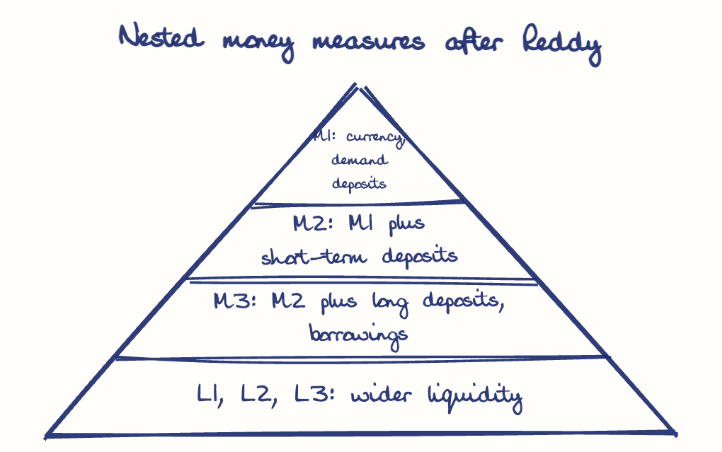
The Y.V. Reddy Working Group (1998) excluded post office deposits from monetary aggregates and redefined them: M1 as currency, demand deposits and other RBI deposits; M2 adding short-term time deposits and CDs; and M3 adding longer deposits and call borrowings. It also introduced liquidity aggregates L1, L2 and L3.
Model answer
Ghissu Editorial · Verified 4 Oct 2026 · 267 words
Exclusion of Post Office Deposits
The Group excluded post office savings deposits from aggregates to better mirror banking liquidity, as these deposits did not reflect the banking sector’s balance sheet accurately.
Data Consistency Issues
Classification of savings deposits improved data quality but posed challenges for cooperative banks in Telangana’s rural areas, where uniform reporting standards were difficult to implement.
Financial Inclusion Considerations
Excluding post office deposits underscored the need to integrate non-bank financial institutions, important for schemes like PMJDY and KCC in Telangana, where significant financial flows occur outside traditional banks.
Liquidity Aggregates Expansion
Inclusion of liabilities of non-depository financial corporations helped capture broader liquidity beyond banks, aiding comprehensive monetary policy formulation.
Integrate Non-Bank Data
Incorporate data from NBFCs and post offices for comprehensive money supply measures, reflecting the full spectrum of financial assets in states like Telangana.
Enhance Reporting Systems
Standardize and digitize bank reporting to improve accuracy and consistency, especially across commercial and cooperative banks.
Leverage Technology
Adoption of real-time data analytics can help monitor liquidity dynamically, benefiting rapidly growing financial hubs such as Hyderabad.
This model answer is indicative and the model can make mistakes; please verify key facts independently.
Practise this question
1Get the answer sheet
Sized for this question.
2Write your answer
Timed, by hand.
3Get it marked
Your score and what to fix.
This chapter in the exam
Money and banking4 questions
Asked in 2 of 2 sittings since 2016
Most tested: RBI-led monetary policy and liquidity management
- 2024Analyse briefly how Liquidity Adjustment Facility (LAF) in India emerged as an effective monetary policy instrument to control market fluctuations in the short run.
- 2016"The Central Bank autonomy is important for conducting a consistent monetary policy" Comment.
All 4 questions, sorted by sub-topic, with model answers and practice.
Question from the official TGPSC Group-I Mains 2024 paper. Answer written by Ghissu's engine and checked against our editorial standards. Found an error? Tell us and we correct it within 48 hours.