What are salient features of the micro-finance model of linking self-help groups with the scheduled commercial banks for women empowerment and poverty eradication?
In short
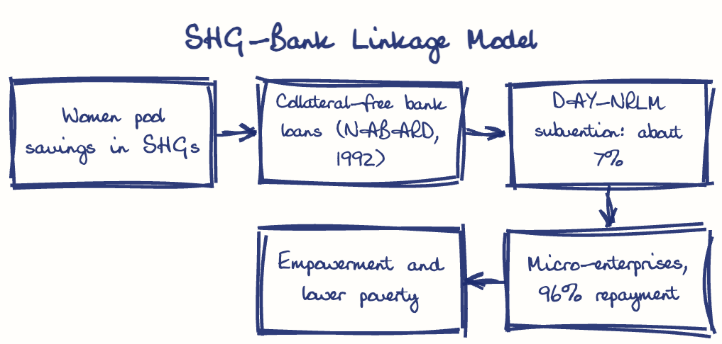
The SHG-bank linkage model, begun by NABARD in 1992, gives poor women collateral-free group credit under priority sector norms, backed by DAY-NRLM interest subvention, training and digital records under EShakti. Repayment exceeds 96%, though low literacy, elite capture and limited digital access still constrain it.
Model answer
Ghissu Editorial · Verified 4 Oct 2026 · 266 words
NABARD’s Linkage Programme
Connects informal women’s groups with banks, enabling collateral-free credit under priority sector norms, formalizing access to finance for poor women.
Government Schemes
DAY-NRLM promotes SHGs by mobilizing millions of women, providing interest subvention (~7%) and livelihood support through Mahila Kisan Shashaktikaran Pariyojana, enhancing rural women’s economic participation.
Digital Integration
Project EShakti digitizes SHG financial and non-financial data, enhancing transparency and scalability, though limited because only about 28% of rural women nationally have internet access, a gap also seen in rural Telangana.
Capacity Building
Financial literacy and entrepreneurship training improve SHG sustainability and effective credit management, empowering women to run micro-enterprises successfully.
Repayment and Trust
SHGs maintain over 96% repayment rates, reflecting strong credit discipline and encouraging banks to continue lending.
Economic Impact
SHGs like Laksh (Rajasthan) enable micro-enterprises such as bangle production, raising incomes and reducing poverty in states like Telangana through increased employment and financial inclusion.
Financial Literacy
Targeted education programmes to improve loan management and governance among SHG members.
Digital Expansion
Enhance rural internet connectivity in Telangana to support platforms like Project EShakti for seamless banking and monitoring.
This model answer is indicative and the model can make mistakes; please verify key facts independently.
Practise this question
1Get the answer sheet
Sized for this question.
2Write your answer
Timed, by hand.
3Get it marked
Your score and what to fix.
This chapter in the exam
Money and banking4 questions
Asked in 2 of 2 sittings since 2016
Most tested: RBI-led monetary policy and liquidity management
- 2024What changes have been introduced in money supply measures as per the recommendations of the Working Group on Money Supply, 1998 chaired by Dr. Y.V. Reddy?
- 2024Analyse briefly how Liquidity Adjustment Facility (LAF) in India emerged as an effective monetary policy instrument to control market fluctuations in the short run.
All 4 questions, sorted by sub-topic, with model answers and practice.
Question from the official TGPSC Group-I Mains 2016 paper. Answer written by Ghissu's engine and checked against our editorial standards. Found an error? Tell us and we correct it within 48 hours.