What are the objectives of Goods and Services Act and what would be its impact on economic growth?
In short
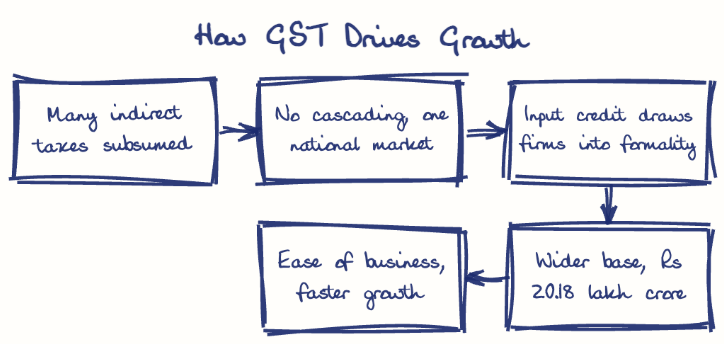
GST, in force from 1 July 2017, aims to create a single national market, end tax cascading, simplify compliance and widen the tax base through the GST Council. It aids growth by formalising the economy, raising indirect taxpayers by about 50% and lifting collections to ₹20.18 lakh crore in FY24.
Model answer
Ghissu Editorial · Verified 4 Oct 2026 · 252 words
Single National Market Creation
GST subsumes multiple indirect taxes, eliminating cascading and enabling seamless interstate trade, benefiting Telangana where services contribute 68.6%1 to GSVA, outpacing national averages.
Simplified Compliance and Administration
The GST Council ensures cooperative federalism and dynamic tax rate adjustments, improving transparency and reducing litigation.
Fiscal Consolidation and Revenue Stability
GST collections reached ₹20.18 lakh crore in FY24, an 11.7% increase, providing stable revenue for infrastructure and social services investment.
Rationalize GST Rates and Strengthen IT
Streamline tax slabs and enhance digital platforms for compliance and policy responsiveness, aiding MSMEs in Telangana.
Capacity Building and MSME Support
Support states technically and integrate GST reforms with schemes like Udyam Assist and Credit Guarantee Fund to boost MSME competitiveness.
This model answer is indicative and the model can make mistakes; please verify key facts independently.
Practise this question
1Get the answer sheet
Sized for this question.
2Write your answer
Timed, by hand.
3Get it marked
Your score and what to fix.
This chapter in the exam
Public finance, budget, monetary and fiscal policy4 questions
Asked in 2 of 2 sittings since 2016
Most tested: Tax reforms and fiscal federalism in India, especially GST and Finance Commission-based tax devolution.
- 2024Evaluate the innovativeness of the Fifteenth Finance Commission on Centre-State relations regarding the sharing of tax revenues.
- 2024"Rising fiscal deficit during the 21st century has been, by and large, responsible for the surge in public debt for the Centre-States in India." Examine.
All 4 questions, sorted by sub-topic, with model answers and practice.
Question from the official TGPSC Group-I Mains 2016 paper. Answer written by Ghissu's engine and checked against our editorial standards. Found an error? Tell us and we correct it within 48 hours.