Evaluate the innovativeness of the Fifteenth Finance Commission on Centre-State relations regarding the sharing of tax revenues.
In short
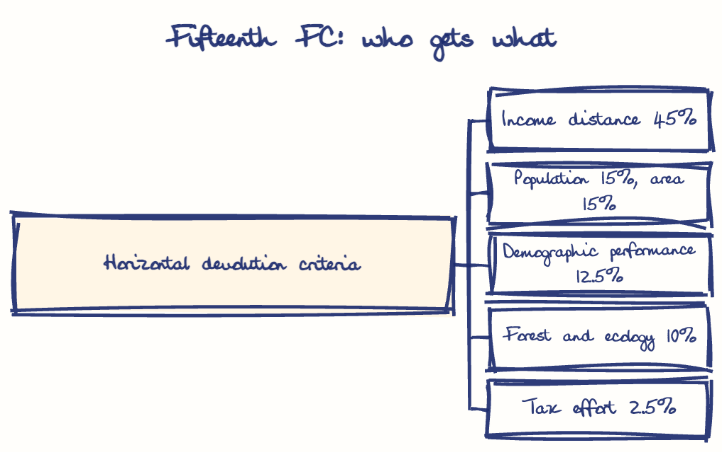
The Fifteenth Finance Commission innovated by adding forest and ecology (10%), demographic performance (12.5%) and tax effort (2.5%) to devolution criteria, setting the states' share at 41% for the new UTs. Its impact on Centre-State relations is partial, as rising cesses and surcharges outside the divisible pool shrink actual transfers.
Model answer
Ghissu Editorial · Verified 4 Oct 2026 · 240 words
Broadened Devolution Criteria
FFC added forest and ecology (10%) and demographic performance (12.5%) to traditional factors like income distance (45%) and population (15%), incentivizing environmental and demographic priorities, benefiting states like Telangana’s agency tracts with tribal populations and forest areas.
Inclusion of Tax Effort and Targeted Grants3
A small weight (2.5%) was given to tax effort to encourage states’ revenue mobilization. Additionally, substantial grants-in-aid were recommended, including Rs 2.94 lakh crore for revenue deficit states and Rs 1.29 lakh crore for sectoral needs like health and education, blending devolution with targeted support.
Shrinking Divisible Pool
Rising cesses and surcharges excluded from the divisible pool reduced states’ effective share from the nominal 41%, limiting FFC’s devolution impact, since these levies are not shared with states.
Partial Vertical Imbalance Addressed
Targeted grants and maintaining a 41% share have helped address vertical fiscal imbalance, but the growing share of non-divisible cesses limits actual resources available to states.
This model answer is indicative and the model can make mistakes; please verify key facts independently.
Practise this question
1Get the answer sheet
Sized for this question.
2Write your answer
Timed, by hand.
3Get it marked
Your score and what to fix.
This chapter in the exam
Public finance, budget, monetary and fiscal policy4 questions
Asked in 2 of 2 sittings since 2016
Most tested: Tax reforms and fiscal federalism in India, especially GST and Finance Commission-based tax devolution.
- 2024"Rising fiscal deficit during the 21st century has been, by and large, responsible for the surge in public debt for the Centre-States in India." Examine.
- 2016What are the changes effected in tax policy in India after the Implementation of the recommendation of Tax Reforms Committee in 1994?
All 4 questions, sorted by sub-topic, with model answers and practice.
Question from the official TGPSC Group-I Mains 2024 paper. Answer written by Ghissu's engine and checked against our editorial standards. Found an error? Tell us and we correct it within 48 hours.