"Rising fiscal deficit during the 21st century has been, by and large, responsible for the surge in public debt for the Centre-States in India." Examine.
In short
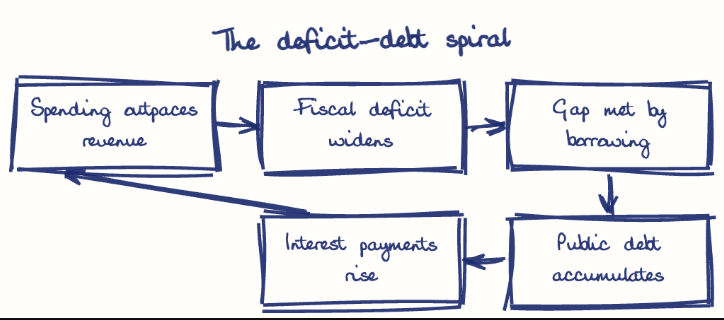
Rising fiscal deficits, driven by salaries, pensions, subsidies, revenue deficits and shocks like COVID-19, have by and large caused the surge in Centre and State debt, since every deficit is financed by borrowing. Costly market borrowings, now over half of state liabilities, and weak revenue mobilisation have added to it.
Model answer
Ghissu Editorial · Verified 4 Oct 2026 · 275 words
Revenue Deficit and Tax Base Issues
Persistent revenue deficits and a narrow tax base with low compliance have forced higher borrowing. Slow growth in direct tax revenues and tax evasion exacerbate fiscal imbalances, compelling governments to depend on debt.
Centre-State Borrowing Dynamics
Article 293 restricts state borrowing, leading to higher costs for states like Telangana, which rely increasingly on market borrowings constituting over 50% of liabilities. The Centre’s control over external borrowings often results in states facing higher interest rates than the original loans.
Fiscal Sustainability and Growth Constraints
Rising debt increases interest payments, crowding out capital expenditure; however, Telangana’s 6.8%1 GSDP growth in 2024-25 shows efficient fiscal management can mitigate risks. High debt burdens limit social and infrastructure spending, risking long-term growth.
This model answer is indicative and the model can make mistakes; please verify key facts independently.
Practise this question
1Get the answer sheet
Sized for this question.
2Write your answer
Timed, by hand.
3Get it marked
Your score and what to fix.
This chapter in the exam
Public finance, budget, monetary and fiscal policy4 questions
Asked in 2 of 2 sittings since 2016
Most tested: Tax reforms and fiscal federalism in India, especially GST and Finance Commission-based tax devolution.
- 2024Evaluate the innovativeness of the Fifteenth Finance Commission on Centre-State relations regarding the sharing of tax revenues.
- 2016What are the changes effected in tax policy in India after the Implementation of the recommendation of Tax Reforms Committee in 1994?
All 4 questions, sorted by sub-topic, with model answers and practice.
Question from the official TGPSC Group-I Mains 2024 paper. Answer written by Ghissu's engine and checked against our editorial standards. Found an error? Tell us and we correct it within 48 hours.