What is Environmentalism? Explain the key features of the India's Environment Protection Act.
In short
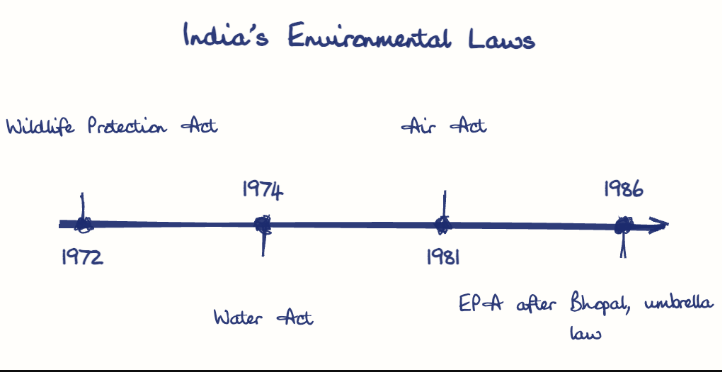
Environmentalism is a social and political movement for protecting and sustainably managing natural resources and ecosystems, grounded in intergenerational equity. The Environment Protection Act, 1986, enacted after Bhopal as umbrella legislation, empowers the Centre to set standards, inspect and penalise polluters, and underpins environmental clearance through EIA.
Model answer
Ghissu Editorial · Verified 4 Oct 2026 · 285 words
Environmentalism and Intergenerational Equity
It advocates protecting natural resources for present and future generations, emphasizing ecological balance and human well-being.
EPA’s Comprehensive Authority
The Act empowers the central government to regulate pollution, set standards, and enforce compliance, complementing laws like the Water (1974) and Air (1981) Acts. It also authorizes inspection, monitoring, and remedial actions against violators.
Regulatory Enforcement
Despite challenges like limited capacity and overlapping jurisdictions, institutions like Telangana State Pollution Control Board actively monitor pollution; the contested clearance of large projects such as the Kaleshwaram Lift Irrigation Scheme before the National Green Tribunal shows why rigorous Environmental Impact Assessment (EIA) matters.
Public Participation and Judicial Activism
Citizens and courts in Hyderabad use EPA provisions to hold polluters accountable, with the National Green Tribunal playing a key role in enforcing environmental laws and enhancing governance.
Institutional Capacity and Community Engagement
Enhancing technical and financial resources for pollution control boards and involving local communities, especially in Telangana’s agency tracts, can improve enforcement and balance conservation with livelihoods.
Technology and Policy Integration
Using GIS, remote sensing, and real-time pollution data, along with aligning development plans with EPA mandates through integrated environmental and social impact assessments, supports sustainable growth.
This model answer is indicative and the model can make mistakes; please verify key facts independently.
Practise this question
1Get the answer sheet
Sized for this question.
2Write your answer
Timed, by hand.
3Get it marked
Your score and what to fix.
This chapter in the exam
Environment vs development, environmental policy3 questions
Asked in 2 of 2 sittings since 2016
Most tested: Balancing economic development with environmental sustainability.
Question from the official TGPSC Group-I Mains 2016 paper. Answer written by Ghissu's engine and checked against our editorial standards. Found an error? Tell us and we correct it within 48 hours.