Critically assess the challenges in aligning economic development with environmental sustainability in India in the present era.
In short
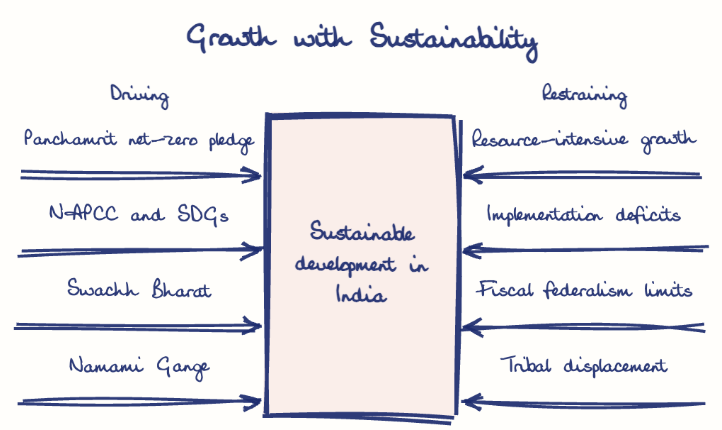
India's resource-intensive growth model, policy contradictions, weak enforcement, federal fiscal constraints and displacement of vulnerable communities keep economic development and sustainability apart despite strong frameworks. Namami Gange had completed only 307 of 406 projects by January 2025, and Telangana's urban bodies dump over 60% of municipal waste unprocessed.
Model answer
Ghissu Editorial · Verified 4 Oct 2026 · 273 words
Resource-Intensive Growth Model
India’s reliance on infrastructure and industrial projects strains natural resources; for example, thermal power expansion and mining in Telangana’s Singareni coal belt boost economy but degrade environment.
Policy Contradictions and Implementation Gaps
Missions like NAPCC exist, yet conflicting priorities slow progress; Namami Gange1 completed only 307 of 406 projects by 2025, reflecting coordination issues that also affect state-level river and waste programmes in Telangana.
Fiscal and Institutional Constraints
Despite Telangana’s 10.7%2 GSDP growth, centralised tax devolution limits fiscal space for sustainable investments, causing uneven regional progress.
Social and Livelihood Pressures
Large projects displace tribal communities in Telangana, with inadequate rehabilitation undermining sustainability.
Equity and Federalism Complexities
Fiscal federalism penalises better-performing states like Telangana, limiting green innovation despite national targets.
Decentralise Governance
Empower states with fiscal autonomy and technical capacity for region-specific sustainability aligned with national goals.
Improve Coordination
Enhance monitoring to accelerate projects like Namami Gange and solid waste management in Telangana.
Inclusive Development
Ensure rehabilitation and livelihood restoration for displaced tribal communities.
This model answer is indicative and the model can make mistakes; please verify key facts independently.
Practise this question
1Get the answer sheet
Sized for this question.
2Write your answer
Timed, by hand.
3Get it marked
Your score and what to fix.
This chapter in the exam
Environment vs development, environmental policy3 questions
Asked in 2 of 2 sittings since 2016
Most tested: Balancing economic development with environmental sustainability.
Question from the official TGPSC Group-I Mains 2024 paper. Answer written by Ghissu's engine and checked against our editorial standards. Found an error? Tell us and we correct it within 48 hours.