Discuss the need for a revamped energy policy to tackle the problems of growing urbanization in India.
In short
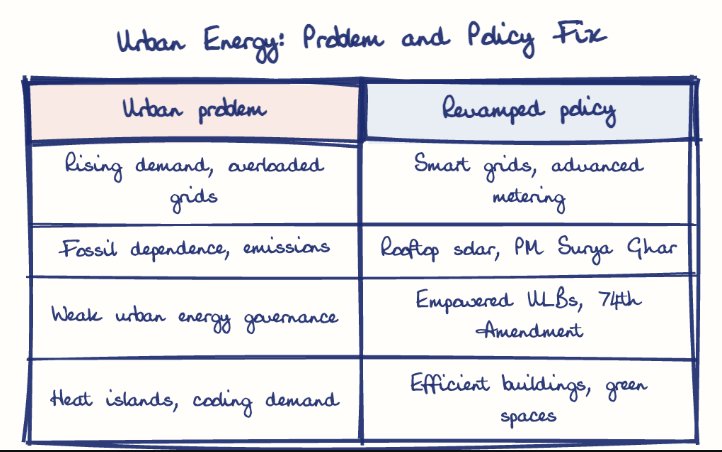
Rapid urbanisation, with India's urban population nearing 600 million by 2030, is raising energy demand, emissions, grid strain and access gaps that the current fossil-heavy policy cannot handle. A revamped policy should promote rooftop solar under PM Surya Ghar, smart grids, efficient buildings, EV infrastructure and stronger urban local bodies.
Model answer
Ghissu Editorial · Verified 4 Oct 2026 · 275 words
Rising Urban Energy Demand
India may need to quadruple power capacity by 2040 for 600 million new electricity consumers, highlighting current policy inadequacies.
Dependence on Fossil Fuels
Continued reliance on fossil fuels risks energy insecurity and environmental harm despite renewable advances.
Infrastructure and Distribution Gaps
Urban sprawl strains grids causing outages in metropolitan areas like Hyderabad’s HITEC City, demanding smart grid reforms.
Energy Access Inequality
Many urban poor in Telangana face unreliable electricity, deepening social inequities.
Promotion of Decentralized Renewable Energy
PM Surya Ghar: Muft Bijli Yojana1’s 6.3 lakh rooftop solar installations nationally, including in Telangana, reduce transmission losses and enhance clean energy access.
Smart Grid and Energy Efficiency Technologies
IoT-enabled smart grids piloted in Hyderabad optimize distribution and reduce theft.
Strengthening Urban Energy Governance
Empowering urban local bodies aligns with the 74th Constitutional Amendment for better energy management.
Incentivizing Clean Energy and Sustainable Urban Planning
Supporting energy-efficient buildings and EV infrastructure complements Telangana’s urban initiatives.
Expand Financial Mechanisms and R&D
Schemes like the National Solar Mission and Production Linked Incentive (PLI) Scheme can scale urban clean energy projects.
Implement Integrated Urban Energy Master Plans
GIS-based planning can optimize energy use and reduce urban sprawl.
This model answer is indicative and the model can make mistakes; please verify key facts independently.
Practise this question
1Get the answer sheet
Sized for this question.
2Write your answer
Timed, by hand.
3Get it marked
Your score and what to fix.
This chapter in the exam
Energy resources and energy security4 questions
Asked in 2 of 2 sittings since 2016
Most tested: Solar energy and renewable-energy policy frameworks.
- 2024A National Mission to promote solar power launched by Indian Government is named as "Jawaharlal Nehru National Solar Mission (JNNSM)" in 2010. Elaborate the mission and its major objectives.
- 2024India's "Ministry of Petroleum and Natural Gas" has published its "National Policy on Bio-fuels" in 2018. Elaborate the Vision, Goals, Strategy and Approach of the policy.
All 4 questions, sorted by sub-topic, with model answers and practice.
Question from the official TGPSC Group-I Mains 2016 paper. Answer written by Ghissu's engine and checked against our editorial standards. Found an error? Tell us and we correct it within 48 hours.