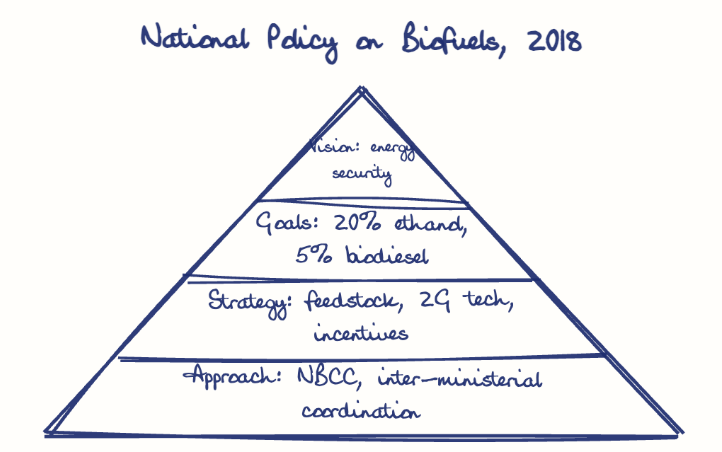
India's "Ministry of Petroleum and Natural Gas" has published its "National Policy on Bio-fuels" in 2018. Elaborate the Vision, Goals, Strategy and Approach of the policy.
In short
The National Policy on Biofuels (2018) sees biofuels as a route to energy security, cleaner air and rural incomes, cutting dependence on crude imports above 87%. It set 20% ethanol blending in petrol (advanced to 2025) and 5% biodiesel by 2030, through diversified feedstock, R&D, incentives and inter-ministerial coordination.
Model answer
Ghissu Editorial · Verified 4 Oct 2026 · 257 words
Energy Security and Blending Goals
The policy aims for 20% ethanol blending by 2025 and 5% biodiesel by 2030, reducing crude oil imports above 87%.
Inter-Ministerial Coordination and Oversight
The National Biofuel Coordination Committee ensures policy implementation with ministries like Agriculture and Road Transport.
Feedstock Diversification and Technology
Use of surplus food grains, molasses, and short gestation crops is promoted alongside R&D in second-generation biofuels and fuel standards (E5, E10, E20).
Economic Incentives and Market Development
Interest subvention for distilleries and administered ethanol pricing encourage private sector participation, benefiting rural economies including Telangana.
Supply and Infrastructure Issues
Feedstock availability and higher costs challenge adoption; vehicle compatibility and fuel infrastructure require upgrades, as seen with E20 fuel standards notified in 2021.
Regional Variability and Monitoring
States like Telangana need tailored strategies; robust monitoring and policy adaptation are essential for success.
Enhance R&D and Infrastructure
Boost funding for advanced biofuels and expand ethanol-compatible vehicles and fuel stations through public-private partnerships.
Farmer-Industry Linkages and Climate Integration
Link farmers through FPOs and assured feedstock purchase, such as maize in Telangana, and align biofuel goals with climate and rural development plans.
This model answer is indicative and the model can make mistakes; please verify key facts independently.
Practise this question
1Get the answer sheet
Sized for this question.
2Write your answer
Timed, by hand.
3Get it marked
Your score and what to fix.
This chapter in the exam
Energy resources and energy security4 questions
Asked in 2 of 2 sittings since 2016
Most tested: Solar energy and renewable-energy policy frameworks.
- 2024A National Mission to promote solar power launched by Indian Government is named as "Jawaharlal Nehru National Solar Mission (JNNSM)" in 2010. Elaborate the mission and its major objectives.
- 2016"Solar energy is claimed to be a panacea for growing energy problems in the country". Comment.
All 4 questions, sorted by sub-topic, with model answers and practice.
Question from the official TGPSC Group-I Mains 2024 paper. Answer written by Ghissu's engine and checked against our editorial standards. Found an error? Tell us and we correct it within 48 hours.