A National Mission to promote solar power launched by Indian Government is named as "Jawaharlal Nehru National Solar Mission (JNNSM)" in 2010. Elaborate the mission and its major objectives.
In short
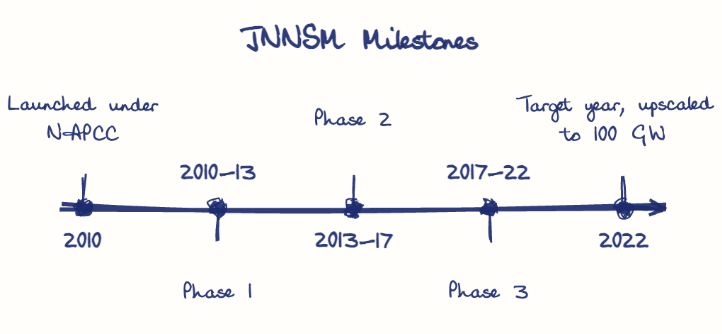
Launched in 2010 under the National Action Plan on Climate Change, JNNSM aims to make India a solar leader through phased targets, domestic manufacturing and supportive policy, with its 2022 goal raised from 20 GW to 100 GW. Solar capacity rose from 2.82 GW (2014) to over 107 GW (mid-2025).
Model answer
Ghissu Editorial · Verified 4 Oct 2026 · 256 words
Phased Implementation and Targets
The mission’s three phases aimed for 20 GW grid and 2 GW off-grid solar by 2022, later upscaled to 100 GW, reflecting evolving technology and policy support.
Policy and Domestic Manufacturing
MNRE leads with policies like Renewable Purchase Obligations and the Production Linked Incentive (PLI) Scheme, promoting solar adoption and indigenous manufacturing.
Capacity Expansion and Cost Reduction
Solar capacity surged from 2.82 GW in 2014 to over 107 GW by 2025, with tariffs dropping nearly 65%, showing successful deployment.
Off-Grid and Rural Electrification
PM-KUSUM and PM Surya Ghar Muft Bijli Yojana4 complement JNNSM by promoting solar pumps and free electricity, benefiting rural areas including Telangana.
Energy Security and Climate Goals
JNNSM helped India meet its 40% non-fossil power capacity goal in 2021, ahead of 2030, and now supports the raised target of 50% by 2030, reducing fossil fuel dependence.
Integration with Other Missions
It aligns with the National Green Hydrogen Mission and Perform, Achieve, and Trade (PAT) Scheme for a holistic energy transition.
Enhance R&D and State Support
Increasing investment in solar technology and empowering states like Telangana is vital for scaling and innovation.
This model answer is indicative and the model can make mistakes; please verify key facts independently.
Practise this question
1Get the answer sheet
Sized for this question.
2Write your answer
Timed, by hand.
3Get it marked
Your score and what to fix.
This chapter in the exam
Energy resources and energy security4 questions
Asked in 2 of 2 sittings since 2016
Most tested: Solar energy and renewable-energy policy frameworks.
- 2024India's "Ministry of Petroleum and Natural Gas" has published its "National Policy on Bio-fuels" in 2018. Elaborate the Vision, Goals, Strategy and Approach of the policy.
- 2016"Solar energy is claimed to be a panacea for growing energy problems in the country". Comment.
All 4 questions, sorted by sub-topic, with model answers and practice.
Question from the official TGPSC Group-I Mains 2024 paper. Answer written by Ghissu's engine and checked against our editorial standards. Found an error? Tell us and we correct it within 48 hours.