"Solar energy is claimed to be a panacea for growing energy problems in the country". Comment.
In short
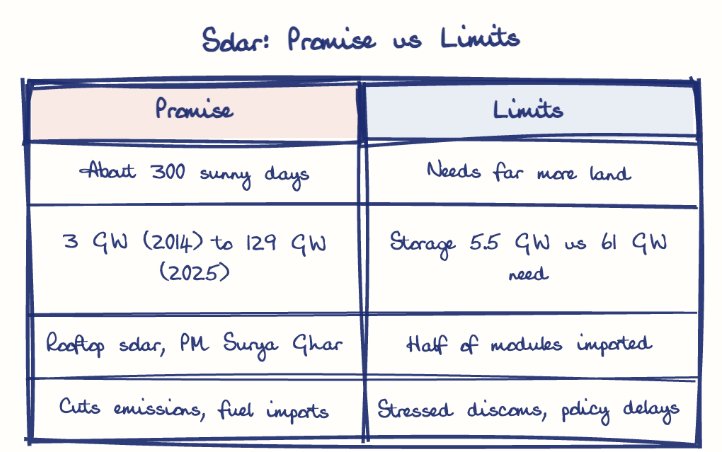
Solar energy is indispensable but not a panacea: it offers abundant, clean and decentralised power, yet faces land conflicts, grid and storage bottlenecks and import dependence. Capacity grew from 3 GW in 2014 to 129 GW in 2025, but storage is near 5.5 GW against 61 GW needed by 2030.
Model answer
Ghissu Editorial · Verified 4 Oct 2026 · 254 words
Abundant Solar Resource and Growth
With 300 sunny days and capacity rising from 3 GW (2014) to 129 GW (2025), solar significantly contributes to over 50% non-fossil installed capacity.
Decentralized Energy Access
PM Surya Ghar Yojana3 has enabled about 24 lakh households nationally to adopt rooftop solar, enhancing rural electrification and reducing diesel dependence.
Storage and Grid Integration Issues
India’s battery storage4 is 5.5 GW against a 61 GW projected need by 2030, causing intermittency and grid reliability problems.
Policy and Implementation Gaps
The Parliamentary Committee on Energy flags delays, inconsistent policies, and financial stress on DISCOMs hindering solar projects.
Complementary Role
Solar’s intermittency and land needs mean it cannot alone solve the energy crisis without other renewables and storage.
Regional Disparities
Solar capacity is concentrated in western and southern states; regions like the North-East lag behind.
Need for Systemic Reforms
Strengthening grid infrastructure and domestic manufacturing, especially in Telangana, is vital.
Expand Storage and Smart Grids
To manage solar variability and ensure stable supply.
Promote PM-KUSUM and Rooftop Solar
Scale decentralized solar in Telangana to reduce land conflicts and improve access.
This model answer is indicative and the model can make mistakes; please verify key facts independently.
Practise this question
1Get the answer sheet
Sized for this question.
2Write your answer
Timed, by hand.
3Get it marked
Your score and what to fix.
This chapter in the exam
Energy resources and energy security4 questions
Asked in 2 of 2 sittings since 2016
Most tested: Solar energy and renewable-energy policy frameworks.
- 2024A National Mission to promote solar power launched by Indian Government is named as "Jawaharlal Nehru National Solar Mission (JNNSM)" in 2010. Elaborate the mission and its major objectives.
- 2024India's "Ministry of Petroleum and Natural Gas" has published its "National Policy on Bio-fuels" in 2018. Elaborate the Vision, Goals, Strategy and Approach of the policy.
All 4 questions, sorted by sub-topic, with model answers and practice.
Question from the official TGPSC Group-I Mains 2016 paper. Answer written by Ghissu's engine and checked against our editorial standards. Found an error? Tell us and we correct it within 48 hours.