What is climate change? Discuss the effects of climate change on Agriculture.
In short
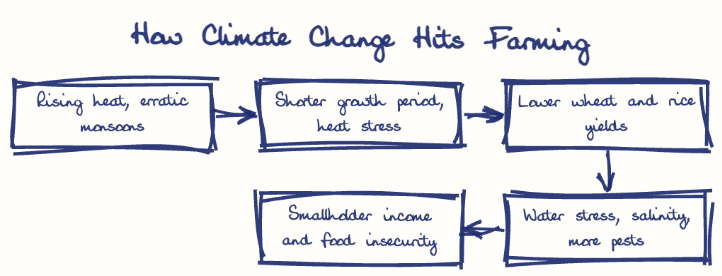
Climate change is the long-term alteration of temperature, rainfall and atmospheric conditions, driven by natural factors and human activity like fossil fuel burning and deforestation. It hurts farming through lower yields, water stress, soil degradation and pests: a 0.5°C winter warming may cut wheat yields by 0.45 tonnes per hectare.
Model answer
Ghissu Editorial · Verified 4 Oct 2026 · 253 words
Causes and Regional Effects
Human activities raise greenhouse gases, having raised temperatures by over 1.1°C above pre-industrial levels; in Telangana, unpredictable monsoons disrupt rainfed farming, addressed by Mission Kakatiya, which restores water bodies to improve irrigation and drought resilience.
Crop and Water Stress
Rising temperatures reduce yields (e.g., wheat drops 0.45 tonnes/ha with 0.5°C rise); erratic monsoons shift cropping patterns from Kharif to Rabi; agriculture’s 80-90% water use faces drought and soil degradation, including salinisation, threatening arable land quality.
Socioeconomic Challenges
Small farmers, especially in Telangana, suffer from fragmented land and limited adaptation capacity; climate shocks increase food insecurity and income instability. Natural farming1 and agroforestry offer climate resilience, particularly empowering women farmers.
Climate-Smart Agriculture
The National Mission on Sustainable Agriculture funds drought-resistant crops and water efficiency; advisories through m-Kisan, market access through e-NAM and crop insurance under PMFBY enhance adaptive capacity.
Water Management and Forecasting
Expanding Mission Kakatiya and Kaleshwaram Lift Irrigation improves water security by increasing storage and distribution; better weather advisories and crop forecasting enable timely decisions and risk mitigation.
This model answer is indicative and the model can make mistakes; please verify key facts independently.
Practise this question
1Get the answer sheet
Sized for this question.
2Write your answer
Timed, by hand.
3Get it marked
Your score and what to fix.
This chapter in the exam
Space applications, disasters and climate4 questions
Asked in 2 of 2 sittings since 2016
Most tested: Space technology for governance applications, especially land records and agricultural insurance.
- 2024In 2016, "Pradhan Mantri Fasal Bima Yojana (PMFBY)" was launched by Govt. of India as an insurance services for farmers for their yield. Describe the role of space technology used in this scheme.
- 2024The "Ministry of Panchayti Raj" of Govt. of India has launched "SVAMITVA" scheme for mapping of land records. Elaborate the role of space technology to help in accomplishing the goal of the scheme.
All 4 questions, sorted by sub-topic, with model answers and practice.
Question from the official TGPSC Group-I Mains 2016 paper. Answer written by Ghissu's engine and checked against our editorial standards. Found an error? Tell us and we correct it within 48 hours.