Critically analyse the role of Command Area Development Programme in alleviating regional inequalities in India.
In short
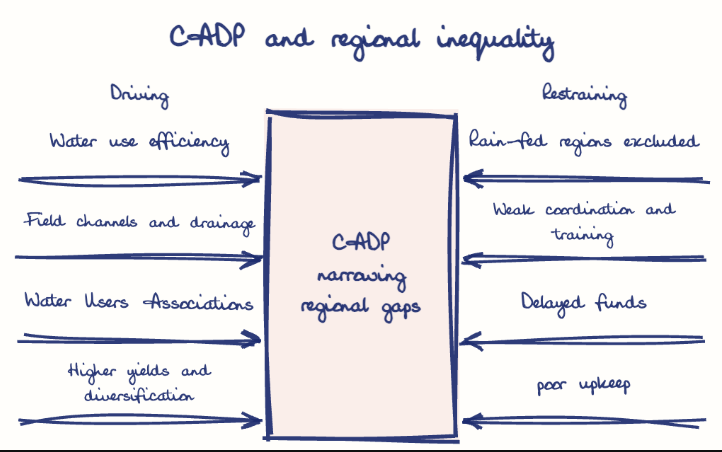
The Command Area Development Programme narrows regional gaps by improving irrigation efficiency, field channels and participatory Water Users Associations in major and medium project commands, raising yields there. But it covers only irrigated commands (about 16 million hectares across 145 projects), leaving the most backward rain-fed regions largely untouched.
Model answer
Ghissu Editorial · Verified 4 Oct 2026 · 284 words
Participatory Irrigation Management
Formation of Water Users Associations fosters equitable water distribution and conflict reduction by involving farmers in decision-making and maintenance of irrigation infrastructure.
Productivity Gains and Farmer Empowerment
CADP has increased crop yields and diversified agriculture in command areas, reducing income gaps between irrigated and rain-fed regions. The empowerment of farmers through Water Users Associations has improved local water governance.
Limited Reach and Mixed Outcomes
Coverage excludes vast rain-fed and drought-prone areas, which remain underdeveloped. Uneven implementation, inadequate maintenance, and socio-political factors have limited CADP’s effectiveness in fully bridging regional disparities.
Strengthen Institutions and Financing
Enhance training for Water Users Associations and field staff, improve inter-agency coordination, and establish dedicated funds for sustainable maintenance of irrigation infrastructure.
Promote Inclusive Access
Design targeted interventions to include marginalized farmers and ensure equitable water distribution within command areas, addressing social inequities and power imbalances.
This model answer is indicative and the model can make mistakes; please verify key facts independently.
Practise this question
1Get the answer sheet
Sized for this question.
2Write your answer
Timed, by hand.
3Get it marked
Your score and what to fix.
This chapter in the exam
India: agriculture, industry, transport, trade, population, urbanisation3 questions
Asked in 1 of 2 sittings since 2016
Most tested: Policy and institutional drivers of agricultural production and spatial inequality
Question from the official TGPSC Group-I Mains 2024 paper. Answer written by Ghissu's engine and checked against our editorial standards. Found an error? Tell us and we correct it within 48 hours.