'The institutional factors have control over the crop production in Indian Agriculture'. Examine.
In short
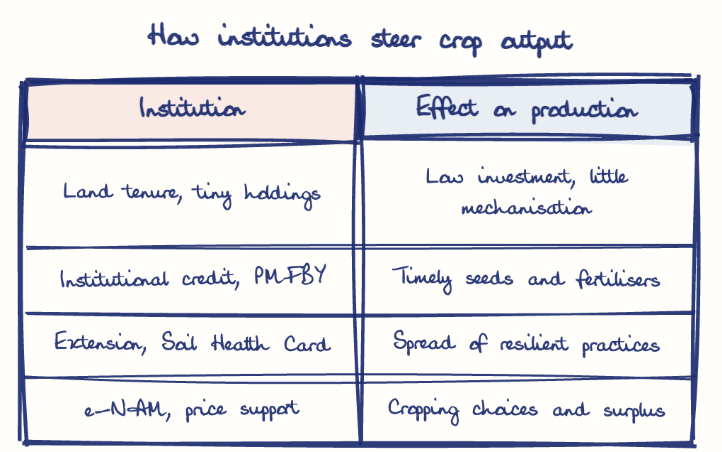
Institutions largely control crop production in India by deciding who owns land, who gets credit, who learns new methods and who reaches markets. Fragmentation leaves 67% of holdings below one hectare, while weak credit, uneven extension and limited MSP and e-NAM reach keep smallholder productivity low.
Model answer
Ghissu Editorial · Verified 4 Oct 2026 · 278 words
Credit and Insurance Schemes
Access to institutional credit through Cooperative Banks and schemes like Pradhan Mantri Fasal Bima Yojana and Modified National Agricultural Insurance Scheme is crucial but insufficient, pushing many towards informal lenders and debt (NITI Aayog, 2022). Limited long-term finance restricts investment in quality inputs and technology adoption.
Extension and Support Services
Programs such as the Soil Health Card Scheme and Accelerated Irrigation Benefit Programme enhance knowledge and resource use but suffer from uneven implementation, especially in rainfed zones where 65% of cropped area depends on monsoon (D R Khullar). This limits adoption of improved seeds, pest management, and irrigation techniques.
Productivity and Welfare Impact
Fragmented landholdings and credit gaps constrain productivity and increase vulnerability, while institutional schemes have improved water use and soil fertility in states like Punjab and Andhra Pradesh. Rising cropping intensity shows intensive land use despite these constraints.
Strengthening Extension and Market Linkages
Enhancing the reach and quality of extension services, especially in rainfed areas, alongside improving market infrastructure through e-NAM, will support technology adoption and better price realization.
This model answer is indicative and the model can make mistakes; please verify key facts independently.
Sources
Practise this question
1Get the answer sheet
Sized for this question.
2Write your answer
Timed, by hand.
3Get it marked
Your score and what to fix.
This chapter in the exam
India: agriculture, industry, transport, trade, population, urbanisation3 questions
Asked in 1 of 2 sittings since 2016
Most tested: Policy and institutional drivers of agricultural production and spatial inequality
Question from the official TGPSC Group-I Mains 2024 paper. Answer written by Ghissu's engine and checked against our editorial standards. Found an error? Tell us and we correct it within 48 hours.