'Strategies for management of rapid urban growth contribute to National and Regional economic growth'. Justify in the context of India's Smart City Mission.
In short
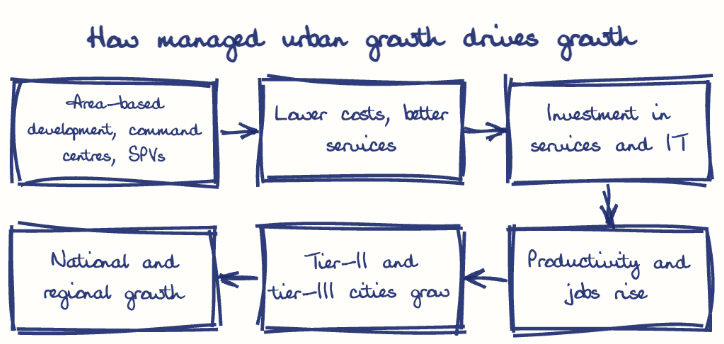
Managed urban growth drives national and regional economic growth, and the Smart Cities Mission (2015) shows how through area-based development, technology-led governance, inclusive infrastructure and SPVs that raise productivity and investment. Over 94% of 8,000 projects are complete, and in Telangana AMRUT has reached 96% fund utilisation.
Model answer
Ghissu Editorial · Verified 4 Oct 2026 · 273 words
Technology-Driven Governance
Integrated Command and Control Centres use AI, IoT, and GIS to improve service delivery, urban mobility, and resource management.
Enhanced Productivity and Job Creation
Efficient infrastructure reduces transaction costs; doubling city size increases productivity by 12%, creating employment.
Attracting Investment and Innovation
Smart Cities offer reliable utilities and digital infrastructure, attracting domestic and foreign investment, especially in IT and services.
Balanced Regional Development
Focus on tier-II and III cities promotes decentralised growth, easing megacity pressure and fostering inclusive regional economies.
Sustainability and Resource Efficiency
Smart energy, water, and waste management align with sustainable development and climate resilience goals.
The mission has completed 94% of 8,000+ projects with ₹1.64 lakh crore invested; all 100 cities have operational Integrated Command and Control Centres. Coimbatore’s lake rejuvenation improved urban livability and economic appeal. Affordable housing and sanitation address urban poverty. Challenges remain in institutional coordination and finance.
In Telangana3, AMRUT4 achieved 96% fund utilisation and 85% project completion5, supporting urban economic activities through water and sewerage projects.
Strengthen Institutional Mechanisms
Empower SPVs and improve inter-agency coordination for seamless implementation.
Enhance Citizen Participation
Use smart platforms to include marginalized urban populations in governance.
This model answer is indicative and the model can make mistakes; please verify key facts independently.
Practise this question
1Get the answer sheet
Sized for this question.
2Write your answer
Timed, by hand.
3Get it marked
Your score and what to fix.
This chapter in the exam
India: agriculture, industry, transport, trade, population, urbanisation3 questions
Asked in 1 of 2 sittings since 2016
Most tested: Policy and institutional drivers of agricultural production and spatial inequality
Question from the official TGPSC Group-I Mains 2024 paper. Answer written by Ghissu's engine and checked against our editorial standards. Found an error? Tell us and we correct it within 48 hours.