Evaluate the effectiveness of current biodiversity conservation strategies implemented in India in conserving endangered species.
In short
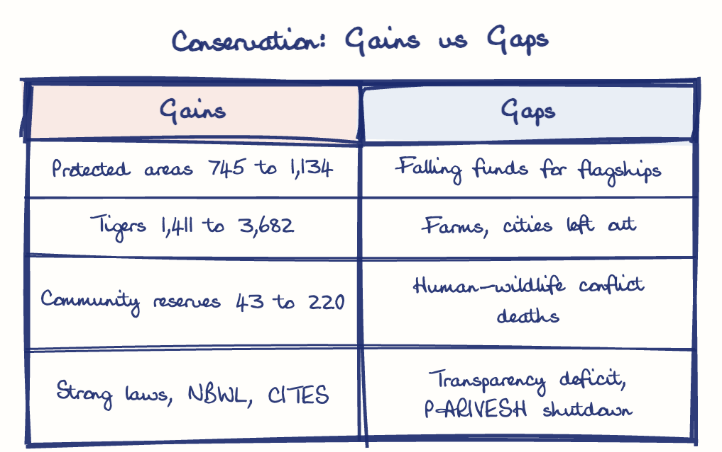
India's conservation strategies have revived flagship species and widened protected areas, but remain narrow, under-funded and weak outside reserves and on human-wildlife conflict. Tigers rose from 1,411 in 2006 to 3,682 in 2022 under Project Tiger, and protected areas grew from 745 in 2014 to 1,134 in 2025.
Model answer
Ghissu Editorial · Verified 4 Oct 2026 · 244 words
Legal and Policy Frameworks
The Wildlife (Protection) Act, 1972, and its amendments provide strong legal protection for Schedule I species; the updated NBSAP 2024-30 emphasizes ecosystem-based management and community involvement.
Community-Based Conservation and Indigenous Knowledge
Rising Community Reserves and initiatives like Telangana’s Mission Kakatiya empower local communities and support aquatic biodiversity.
Strengths
Robust legal frameworks and institutions like the National Board for Wildlife, plus expanding protected areas and community participation, underpin conservation efforts.
Weaknesses
Funding cuts, bureaucratic opacity, restricted research access, and neglect of non-protected ecosystems limit effectiveness; human-wildlife conflicts remain a critical challenge.
This model answer is indicative and the model can make mistakes; please verify key facts independently.
Practise this question
1Get the answer sheet
Sized for this question.
2Write your answer
Timed, by hand.
3Get it marked
Your score and what to fix.
This chapter in the exam
Ecosystems and biodiversity4 questions
Asked in 2 of 2 sittings since 2016
Most tested: Biodiversity conservation and its practical management
- 2024"Proper functioning of various components of eco-system is the basis for maintaining pollution-free environment." Discuss.
- 2016Define bio-diversity and explain major threats to biodiversity.
All 4 questions, sorted by sub-topic, with model answers and practice.
Question from the official TGPSC Group-I Mains 2024 paper. Answer written by Ghissu's engine and checked against our editorial standards. Found an error? Tell us and we correct it within 48 hours.