Discuss the role of sustainable and organic farming practices towards achieving Food Security in India.
In short
Sustainable and organic farming support food security by restoring soil health for stable yields, improving nutritional security, building climate resilience and opening export markets, backed by schemes like PKVY and NMSA. Initial yield losses of 20-30%, weak awareness and costly certification must be addressed for wider adoption.
Model answer
Ghissu Editorial · Verified 4 Oct 2026 · 246 words
Soil Health and Stable Yields
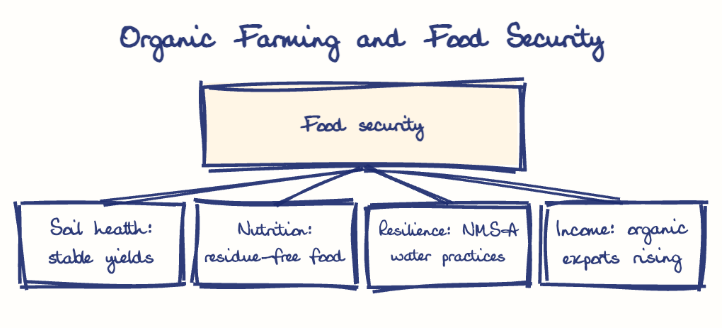
Sustainable practices using bio-fertilisers and crop2 rotation under NMSA maintain soil fertility and reduce degradation, ensuring consistent food production.
Nutritional Security and Health
Organic produce free from harmful chemicals supports better health, crucial for a productive population post-pandemic.
Climate Adaptation
Rainwater harvesting and drip irrigation under NMSA enhance resilience against floods and droughts, securing farmer livelihoods and food supply.
Economic Opportunities
India’s organic exports expected to hit USD 2,601 million by 2026 improve farmer incomes and global market presence.
Yield Penalties and Financial Risks
Initial 20-30% yield drops require financial support; schemes like PM-KISAN can mitigate risks for small farmers.
Awareness and Certification
Limited knowledge and high certification costs hinder adoption; Participatory Guarantee System (PGS) and PKVY aid market access.
Financial and Insurance Support
Expand PKVY and crop insurance tailored for organic farmers.
R&D Investment
Boost research on organic inputs and climate-resilient crops via Telangana’s institutions.
This model answer is indicative and the model can make mistakes; please verify key facts independently.
Practise this question
1Get the answer sheet
Sized for this question.
2Write your answer
Timed, by hand.
3Get it marked
Your score and what to fix.
This chapter in the exam
Food technology, food safety, organic farming, safe drinking water2 questions
Asked in 2 of 2 sittings since 2016
Most tested: Organic/sustainable farming as a route to food security.
Question from the official TGPSC Group-I Mains 2024 paper. Answer written by Ghissu's engine and checked against our editorial standards. Found an error? Tell us and we correct it within 48 hours.