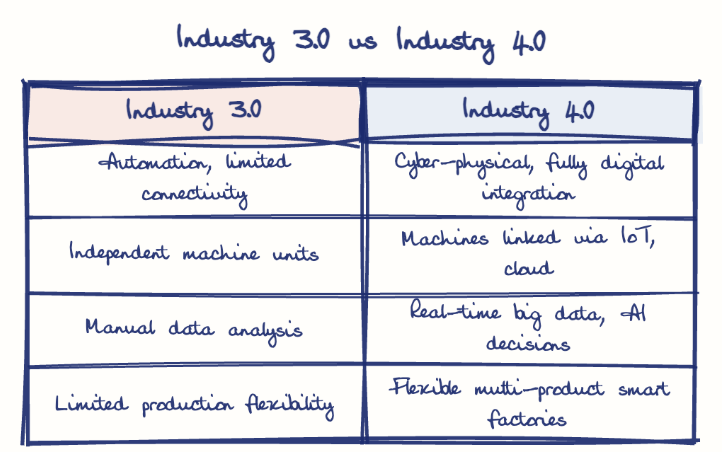
Indian manufacturing sector is shifting from Industry 3.0 to Industry 4.0. Elaborate advantages and challenges involved in adopting Industry 4.0.
In short
Industry 4.0 uses cyber-physical systems, IoT, AI and big data to build smart factories, raising productivity, supply-chain resilience, high-value jobs and global competitiveness. Its adoption is held back by weak digital infrastructure, skill deficits, high upfront costs for MSMEs (35.4% of manufacturing output) and cybersecurity risks.
Model answer
Ghissu Editorial · Verified 4 Oct 2026 · 346 words
Boosted Productivity and Efficiency
Industry 4.0 enables real-time data exchange and automation, reducing downtime and production cycle times; General Electric’s Pune smart factory exemplifies this by drastically cutting line switchover times.
Stronger Supply Chains
Advanced analytics and IoT help MSMEs (35.4% of output) optimize delivery and inventory, enhancing resilience and reducing wastage.
Job Creation and Skill Development
Industry 4.0 demands digital skills, creating jobs in AI, robotics, and data analytics. Initiatives like Skill India and training at IITs and IISc are crucial, especially benefiting Telangana’s IT and manufacturing sectors.
Global Competitiveness and Export Growth
Enhanced product quality and innovation boost exports, as seen in electronics exports reaching USD 22.2 billion in H1 FY263 and mobile manufacturing units in India growing from 2 in 2014-15 to 300 in 2024-25, with Hyderabad emerging as an electronics hub.
High Costs and Cyber Risks
Initial investments in smart machinery and software are steep despite PLI incentives; inadequate cybersecurity frameworks raise risks of data breaches and operational disruptions.
Skill Enhancement and Awareness
Expand Skill India and specialized training programs to bridge the digital skills gap and promote Industry 4.0 benefits among MSMEs.
This model answer is indicative and the model can make mistakes; please verify key facts independently.
Practise this question
1Get the answer sheet
Sized for this question.
2Write your answer
Timed, by hand.
3Get it marked
Your score and what to fix.
This chapter in the exam
Science and technology as an engine of national development3 questions
Asked in 1 of 2 sittings since 2016
Most tested: Science and technology as policy-enabled development: urban management, industrial modernization, and innovation/IPR.
Question from the official TGPSC Group-I Mains 2024 paper. Answer written by Ghissu's engine and checked against our editorial standards. Found an error? Tell us and we correct it within 48 hours.